
Why are human babies so helpless at birth? A foal stands within hours of being born.
It is unsteady. It staggers. But it is upright, and it is moving, and within a day it can keep pace with the herd. A baby elephant walks the same day. A baby shark swims the same minute.
These are not exceptional cases. Across most of the animal kingdom, newborns arrive ready, or close to it.
And then there is the human baby.
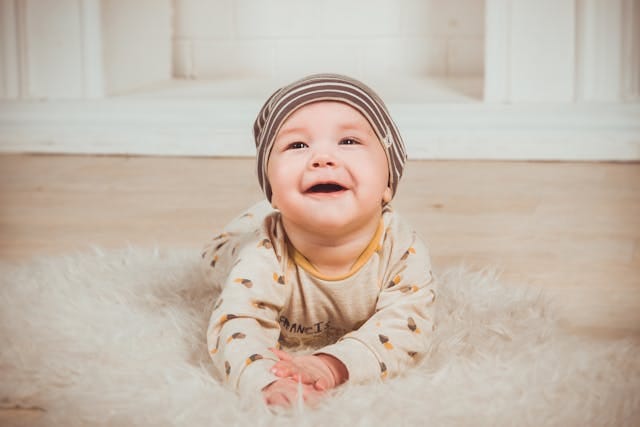
A human newborn cannot hold its own head up. It cannot roll over. It cannot feed itself, move toward warmth, or signal its location to anything other than the parent hovering over it.
For months, it will do almost nothing independently. For years, it will remain in a state of dependence that would be catastrophic for any other species on earth.
For most of scientific history, this was treated as an unfortunate consequence of other pressures. The skull had to be small enough to survive birth.
The brain had to be delivered before it outgrew the birth canal. Human helplessness was an awkward compromise, a necessary flaw.
Now, a latest Study about human babies shows why we are helpless at birth.
New research from the University of Ottawa, published in Child Development Perspectives, says that framing has it completely backwards.

Why are human babies helpless compared to animals
Lead researcher Stuart Hammond argues that human infant helplessness is not a byproduct of our evolution. It is a driver of it.
The key insight is a distinction that sounds simple but carries enormous weight. Human babies are uniquely different from all other newborns in one specific way. They are not uniformly immature.
They arrive with highly developed sensory systems and almost no motor capability at all.
A rat is born with weak senses and weak movement. A horse is born with strong senses and strong movement. The human infant is born with strong senses and almost no movement. Eyes open. Ears open. Brain actively processing. Body completely dependent.
This combination, sensory-rich and motor-poor, does not appear anywhere else in the animal kingdom. And it is not an accident.
Evolution did not fail to give us capable babies. It gave us a different kind of capable. One that needed other people to survive.
That distinction matters more than it might seem. A newborn that can move can, in principle, fend for itself. It can flee. It can seek warmth. It can, in its limited way, act on the world.
A newborn that can only perceive cannot. It is entirely dependent on the world coming to it. On someone else responding.
On a web of attention and care forming around it before it can form one itself.
That web is not a side effect of infant helplessness. According to the research, it is the whole point.

The Trap That Built a Species
Here is what the research suggests happened.
A baby that cannot move but can watch, process, and respond to faces and voices needs constant, attentive care. Not occasional care.
Not rotational care. Someone needs to be there, paying attention, interpreting signals, and responding to them with accuracy and consistency.
That is an extraordinarily demanding cognitive task.
To keep these fragile, helpless infants alive, the adults around them had to become better at reading intention, better at coordination, better at communicating across the group.
Fathers, grandparents, siblings, community members all had to develop the capacity to understand what the infant needed and work together to provide it.
The helpless infant, by requiring so much, drove the evolution of the very social intelligence that would eventually build language, culture, and moral reasoning.
The infant could not walk toward its community. So the community had to build itself around the infant.
Hammond’s team calls this the catalyst hypothesis. The helplessness was not the unfortunate price of having big brains. The helplessness was what forced us to develop them.
“Having useless babies is what makes us special,” as one researcher in the field put it. The uselesness was never the problem. It was the engine.

What the Baby Is Actually Doing
There is another dimension to this that recent neuroscience has added.
The human brain at birth is not as immature as was long assumed. Neuroimaging studies now show that brain connectivity and functional activation in newborns share significant similarities with the mature brain.
The systems are there. What is missing is the data to run them on.
Researchers at Trinity College Dublin proposed that the helpless period is, in effect, a period of intensive pre-training.
The infant cannot act on the world, but it is watching everything.
Absorbing patterns. Processing faces, voices, emotional tones, social dynamics. Building, in the language of the researchers, a foundation model, a set of deep representations that will underpin all later learning.
The passivity is deceptive. Inside the stillness, something enormous is being built.
A horse learns to walk in hours because it needs to. A human takes a year, and uses that year to learn something the horse never will.
How to read a room. How to understand intention. How to navigate a world that runs on meaning rather than muscle.
The slowness is the lesson. The helplessness is the curriculum.
The Morality That Grew From Need
There is one more implication in Hammond’s research that deserves its own moment.
He suggests that human morality, our deep, species-wide sense that vulnerable things deserve protection, did not emerge from philosophy or religion or social contract. It emerged from infants.
When you cannot survive without someone choosing to care for you, care becomes foundational. It becomes the first condition of existence.
The bond between infant and caregiver, forged under conditions of total dependency, is where the instinct to protect the helpless begins.
Extend that instinct outward through generations, through culture, through the gradual recognition that other people are vulnerable in ways that matter, and you arrive, eventually, at the moral frameworks humans have spent millennia debating.
The argument started with a baby who could not lift its own head.
It will continue as long as we have the capacity to care about things that need us.
What It Means Now
Every new parent has experienced the weight of this, usually around 3am, usually with a baby that will not settle.
The feeling is not just exhaustion. It is something more vertiginous. The realisation that this small thing is completely at your mercy.
That you are the entire world to something that cannot yet imagine a world without you.
That feeling is not incidental. It is not a side effect of sleep deprivation, though sleep deprivation sharpens it considerably.
It is the activation of something the research now suggests was built into the whole arrangement by design.
The helplessness of the baby triggers the deepest responses in the adult. The depth of that response is what built our capacity for depth.
We were never meant to do this alone. The helpless infant made sure of that.
The most defenceless thing we have ever been is also the reason we became everything we are.
Read Next: Before Ikigai and Maslow, there was Purushartha.
What is dharma? what the mahabharata knew about losing everything
Can childhood trauma Cause IBS and stomach problems?
Does your partner change your personality? the research says more than you think

 Psychology · Oct 17, 2026A Monkey Bite Killed the King of Greece
 Psychology · Oct 15, 202615 Surprising Facts That Sound Completely Made Up
 The Margin · Oct 13, 202615 Geography Facts That Sound Completely Made Up