
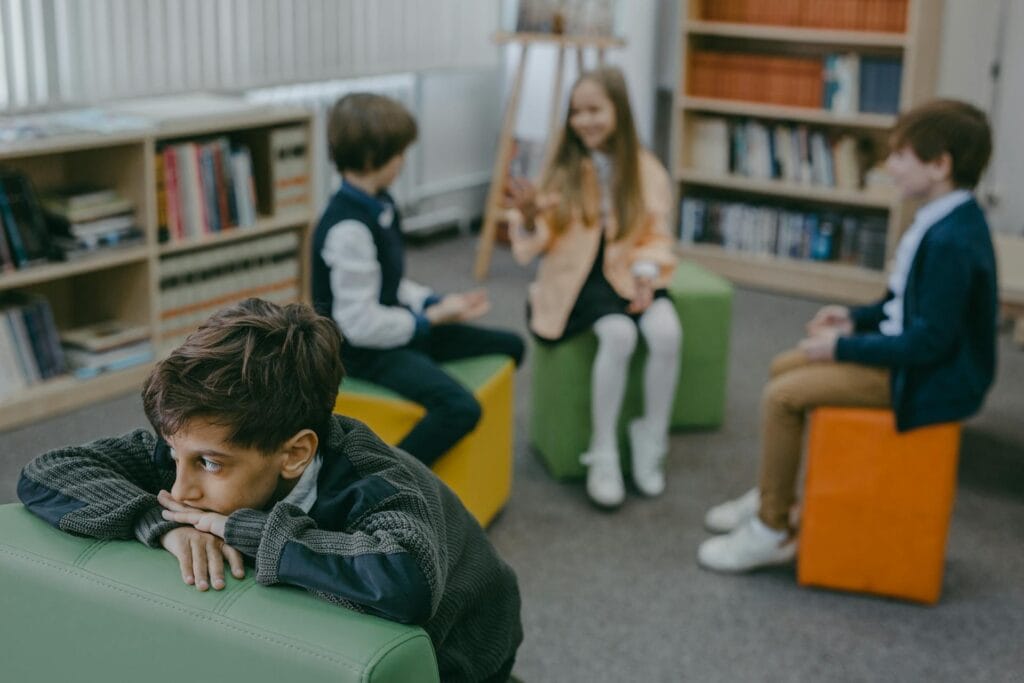
Why are some people quiet in groups but shine up when approached one to one?
Silence in shared spaces attracts meaning whether or not it earns it. Pauses are filled in by observers. Hesitation is assumed. Uncertainty is projected.
From the outside, the absence of speech looks like absence of thought.
Group environments move quickly. Conversations overlap. Signals stack. Presence is asserted through speed rather than depth. The person who reacts first is treated as capable. The person who waits is often bypassed.
No one announces this rule, but everyone feels it.
Place the same person in a one to one conversation and the pattern breaks. Their responses sharpen. Their listening deepens. Connections form cleanly. People leave those conversations surprised by how much clarity was present all along.
The difference is not confidence.
It is conditions.
By the time this contradiction becomes visible, it already carries judgment. Quietness has been read as lack. Sharpness arrives too late to undo the assumption.

When Being Quiet in Groups Distorts Perception
Groups reward momentum. They do not reward sequencing.
In group settings, thinking and speaking are expected to happen simultaneously. Ideas must arrive fully formed or be abandoned. Interruptions are normalised. Attention is split across voices, expressions, and social signals.
For certain minds, this environment works well. Thought is associative. Speech clarifies thinking rather than following it. The group energises rather than fragments attention.
For others, the group interrupts thought before it can organise itself. Ideas require internal ordering. Meaning forms in layers rather than flashes. When the environment does not pause, thinking stalls.
This is not slowness.
It is sequencing.
Silence here is not absence. It is processing.
The problem is that processing is invisible. Groups mistake visibility for intelligence and immediacy for engagement. Over time, this misreading becomes structural. People stop waiting. They stop inviting contribution. Expectations lower quietly.
The feedback loop forms.
The environment discourages participation. The lack of participation is then treated as evidence.
One to one conversations dissolve that loop. Attention narrows. Pace slows. Interruptions drop. Thought is allowed to arrive intact.
This shift is not subtle for those who experience it.
Listening becomes active rather than defensive. Responses grow precise. Questions land where they should. The conversation becomes about coherence rather than positioning.
This is why people who are quiet in groups often appear unusually perceptive in private. They notice nuance. They track inconsistencies. They remember details others miss.
Their intelligence is relational, not performative.
“You’re so articulate,” people say, surprised.
As if articulation were a personality trait rather than a function of environment.

The Environments That Reward Noise
Modern life increasingly favours performative spaces. Meetings, panels, group calls, brainstorming sessions. Visibility becomes currency. Speaking signals participation regardless of substance.
In these spaces, those who require internal sequencing are disadvantaged. Not because they lack clarity, but because clarity arrives on a different timeline.
This does not mean group communication is flawed. It means it is selective.
When a culture consistently rewards one mode of expression, it begins to mistake that mode for intelligence itself. Noise becomes competence. Silence becomes deficiency.
This misreading extends beyond work. It shapes classrooms, social hierarchies, and friendships. Those who speak easily in groups are assumed to be socially fluent. Those who speak selectively are underestimated.
Over time, this misinterpretation erodes self trust.
People begin to question their sharpness because it does not appear where it seems to matter most. The erosion is quiet. It happens through being passed over. Through lowered expectations. Through surprise when one to one clarity finally appears.
There is a broader implication here.
Intelligence is not fixed. It is environmentally responsive. It emerges or recedes depending on the conditions placed around it.
Some minds need space to deepen. Others need friction to spark. Neither is superior. But when only one is recognised, the other becomes invisible.
This invisibility shapes who is trusted, who is promoted, who is listened to. It decides which ideas survive long enough to influence direction.
A related tension appears in The Year That Never Happened, where effort loses coherence when it is forced into rhythms that do not support it.
The cost is not just professional.
There is a quieter fatigue that comes from being consistently mis-seen.
The Private Cost of Being Misread
People who are sharp one to one often adapt by withdrawing publicly and overperforming privately. Influence is built through side conversations, follow ups, and informal exchanges.
This works.
It also exhausts.
Their ideas shape outcomes without shaping recognition. Their contributions matter without being visible. Over time, this produces a weariness that is difficult to name.
Not the fatigue of overwork.
The fatigue of translation.
There is also an emotional cost. Silence becomes strategic rather than natural. Speaking feels risky because it requires compressing thought into fragments that feel dishonest.
Restraint is misread as disengagement.
Discernment is mistaken for hesitation.
Not all silence is passive.
Some silence is refusal. An unwillingness to dilute thought for the sake of occupying space.
In digital environments, this dynamic intensifies. Group spaces extend into feeds, threads, and calls where speed and volume dominate. The pressure to respond quickly grows stronger. Thought becomes compressed.
The cost of this compression appears elsewhere. In attention fatigue. In shallow certainty. In conversations that feel full but leave nothing behind.
For those who already struggle to think in fragments, this environment compounds the problem. It does not reduce intelligence. It hides it.
A disruption enters here and refuses resolution.
Maybe group silence is not always about cognition at all. Maybe it is resistance. A quiet refusal to compete for attention in systems that confuse dominance with clarity. Maybe some people are not failing to adapt, but choosing not to.
This thought does not settle.
Why Are Some People Quiet in Groups: Takeaway
The solution is not for everyone to speak more. Nor is it for groups to slow down entirely. It is to recognise that sharpness has environments, just as silence has meanings.
Some people think best out loud.
Others think before they speak.
Flattening these differences costs insight.
The quiet person in the group is not waiting for encouragement. They are waiting for conditions that allow their thinking to arrive whole.
One to one, those conditions exist.
This does not mean retreating into private spaces. It means being cautious about what is rewarded, what is assumed, and what is overlooked.
Not every mind blooms in public.
Some sharpen in proximity. Some clarify in continuity. Some require a listener rather than an audience.
When these distinctions are ignored, absence is mistaken for weakness and noise for substance.
Something valuable slips out of reach.
And most rooms never notice what they lost.
Further Reading: What I learnt from my kurdish barber in london

 Psychology · Sep 22, 2026Chimpanzees Have Accents. They Grow into Them.
 The Margin · Sep 17, 2026People Are Seeing Ads in Their Dreams.
 Slow Meridian · Sep 16, 2026Autumn Leaves