Pretend play apes. That sentence would have been scientifically controversial five years ago.
It is now the conclusion of a peer-reviewed study published in the journal Science in February 2026. Researchers at Johns Hopkins University and the University of St Andrews set up a tea party with empty cups, an empty pitcher, and a bonobo named Kanzi. They poured imaginary juice. They asked Kanzi where the juice was.
He pointed to the right cup.
Not once. Not by accident. Consistently, across three experiments, with imaginary juice and imaginary grapes, a 43-year-old bonobo demonstrated that he could track an object that did not exist. That he could hold a fiction in his mind and reason about it.
That is imagination. And it has not been uniquely human for a very long time.
The Bonobo Who Bridged Two Worlds
Kanzi’s name means treasure in Swahili. He was born in 1980, raised among humans at the Great Ape Trust in Iowa, and over the course of his life became arguably the most cognitively studied non-human animal in history.
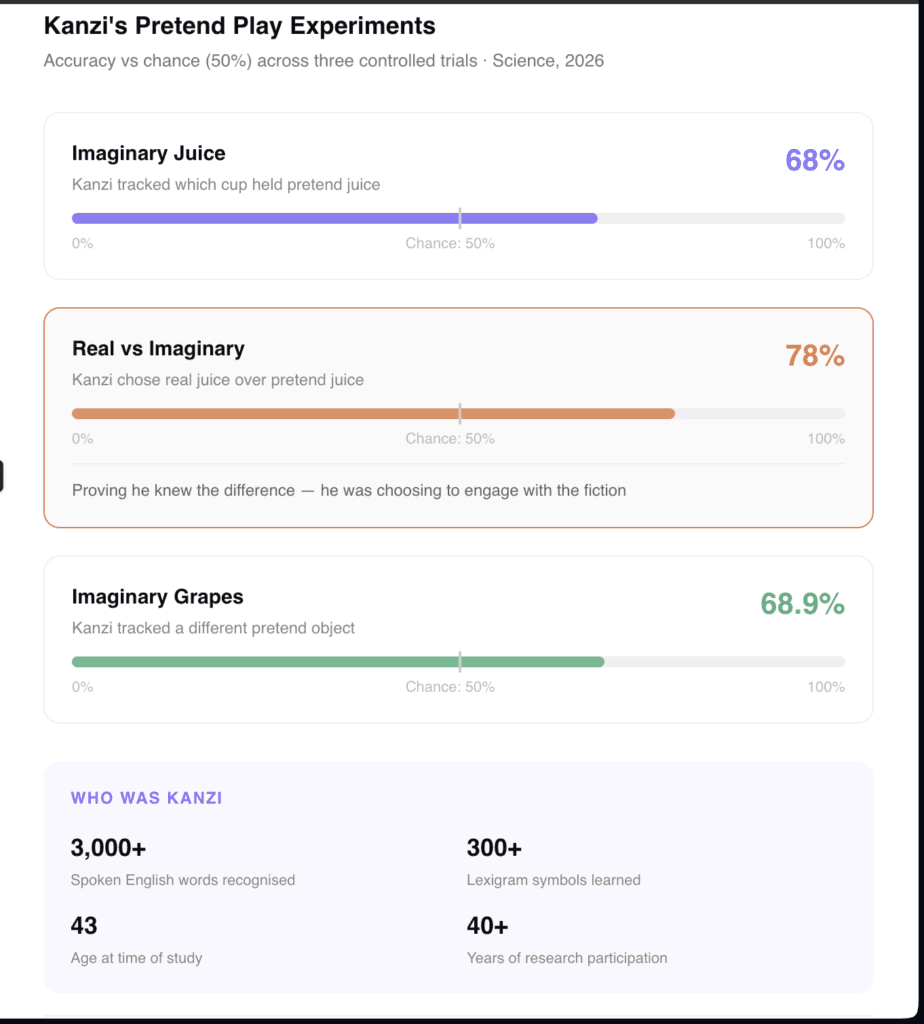
He learned to communicate using a lexigram board, a keyboard of over 300 symbols representing words. He did not just learn to associate symbols with rewards. He combined symbols to make new meanings. He recognised over 3,000 spoken English words. He learned to knap flint into tools after watching a demonstration. He once used his lexigram to ask researchers to chase each other and then watched, delighted, as they did.
His favourite food was onions. His favourite game was chase. He died in March 2025 at the age of 44, of heart disease, a year after the experiments that would become his final contribution to science.
Dr Christopher Krupenye, one of the lead researchers, described him as a bridge between two worlds. Uniquely qualified to help prove that the human mind is not a lonely island.
What the Tea Party Actually Proved
The experiment was modelled on developmental psychology studies from the 1980s that tested pretend play in human toddlers.
Two empty, transparent cups were placed on a table. An empty, transparent pitcher was used to pour imaginary juice into both cups. Then the imaginary juice was poured out of one cup and back into the pitcher. Kanzi was asked: where is the juice?
He pointed to the cup that still contained the imaginary juice 68 percent of the time. Significantly above chance. Consistently across repeated trials.
The sceptic’s objection is reasonable: maybe Kanzi was just tracking the researcher’s gestures rather than representing an imaginary object in his own mind. The researchers ran a control. They presented Kanzi with one cup containing real juice and one cup containing imaginary juice, and asked which he wanted. He chose the real juice 78 percent of the time. He was not confused. He knew perfectly well which cup was empty. He was choosing to engage with the fiction when real rewards were not on offer.
A third experiment replaced juice with imaginary grapes. Kanzi tracked them with 68.9 percent accuracy and did so faster than in the first experiment, as though the task had become familiar.
The researchers’ conclusion was precise: the capacity for representing pretend objects is not uniquely human.
The Question This Reopens
Jane Goodall’s discovery that chimpanzees make and use tools in the wild prompted a famous response. The scientist Louis Leakey said: now we must redefine tool, redefine man, or accept chimpanzees as humans.
The Kanzi study invites the same reframing. Imagination, the ability to hold a version of the world that is not real while knowing that it is not real, has been treated for decades as the cognitive frontier that separates humans from every other species. The capacity underlying art, fiction, planning, empathy and invention.
It is the thing that allows you to read a novel and feel genuine grief for a person who does not exist. That allows an engineer to imagine a bridge before a single piece of steel is placed. That allows a child to turn a bedroom into a castle and truly inhabit it.
If the roots of that capacity go back 6 to 9 million years to the common ancestor of humans and great apes, then imagination is not a human invention. It is a primate inheritance.
Dr Krupenye put it directly: if some roots of imagination are shared with apes, that should make people question their assumption that other animals are just living robotic lifestyles constrained to the present.
What Was Already Known
The Kanzi study did not arrive without context. For decades, researchers had been accumulating anecdotal observations that pointed toward something.
Young female chimpanzees in Uganda, observed over a 14-year period in the wild, were seen carrying sticks and logs and treating them like infants, cradling them, protecting them, placing them in nests. A captive chimpanzee was observed on two separate occasions dragging what appeared to be imaginary wooden blocks across the floor after playing with real ones, repeating the same movements with nothing in his hands.
The anecdotal evidence was suggestive but scientifically unsatisfying. The behaviours could be explained other ways. The Kanzi study was the first controlled experimental test. The first time the question was asked rigorously and the answer came back clearly.
It also raised the question that the research community is now organising around. Kanzi was enculturated, raised from birth in a human environment, exposed to human language and social behaviour in ways that wild bonobos are not. His abilities may reflect what great apes are capable of under specific conditions. Whether those same capacities exist in wild populations remains to be tested.
Dr Amalia Bastos, the study’s co-author, said her next step is to run similar experiments with apes who did not have Kanzi’s unusual upbringing. The results of those studies will determine how far the finding extends.
The Uncomfortable Implication
There is a particular human habit of defining ourselves by contrast with other species, then revising the contrast when the evidence does not support it.
We are the only tool users. Until Goodall. We are the only species that passes the mirror test. Until elephants and dolphins did. We are the only animals with theory of mind, the ability to attribute mental states to others. Until research with chimpanzees, bonobos and ravens complicated the picture. We are the only ones who play pretend.
Until Kanzi, with an empty cup and a patient researcher, pointed to where the imaginary juice was.
Each revision is described as a discovery about animals. It is also a discovery about ourselves. About how persistently and creatively we draw the boundary of human uniqueness, and how reliably the natural world finds ways to blur it.
The philosopher Cathal O’Madagain made a point worth sitting with. Human invention is tightly linked to imagination. You cannot invent a bicycle if you cannot imagine one first. If animals can imagine in ways we previously denied, it reframes what their tool use means. What their problem-solving means. What their lives mean.
The researchers ended their paper with a sentence that is, in its quiet way, one of the more remarkable statements in recent science. We should be compelled by these findings to care for these creatures with rich and beautiful minds, and ensure they continue to exist.
Bonobos are critically endangered. Their forest habitat in the Democratic Republic of Congo is under sustained pressure from deforestation and conflict. The species that just told us something true about the origins of imagination is disappearing.
Kanzi died before the paper was published. He was 44. His favourite food was onions. His favourite game was chase.
He spent his last research session pointing at cups of imaginary juice and getting it right.
Read next: Why Humans Explore: The One Drive Behind All Ambition

 Psychology · Sep 22, 2026Chimpanzees Have Accents. They Grow into Them.
 The Margin · Sep 17, 2026People Are Seeing Ads in Their Dreams.
 Slow Meridian · Sep 16, 2026Autumn Leaves