Attention economy news cycle reached a kind of peak absurdity this week.
On Monday morning, Tim Cook posted a short video to his social media accounts. Colourful Apple logo. The hashtag #AppleLaunch. A teaser for what he called a big week ahead, with at least five new products rolling out across three days, culminating in press events simultaneously in New York, London and Shanghai.
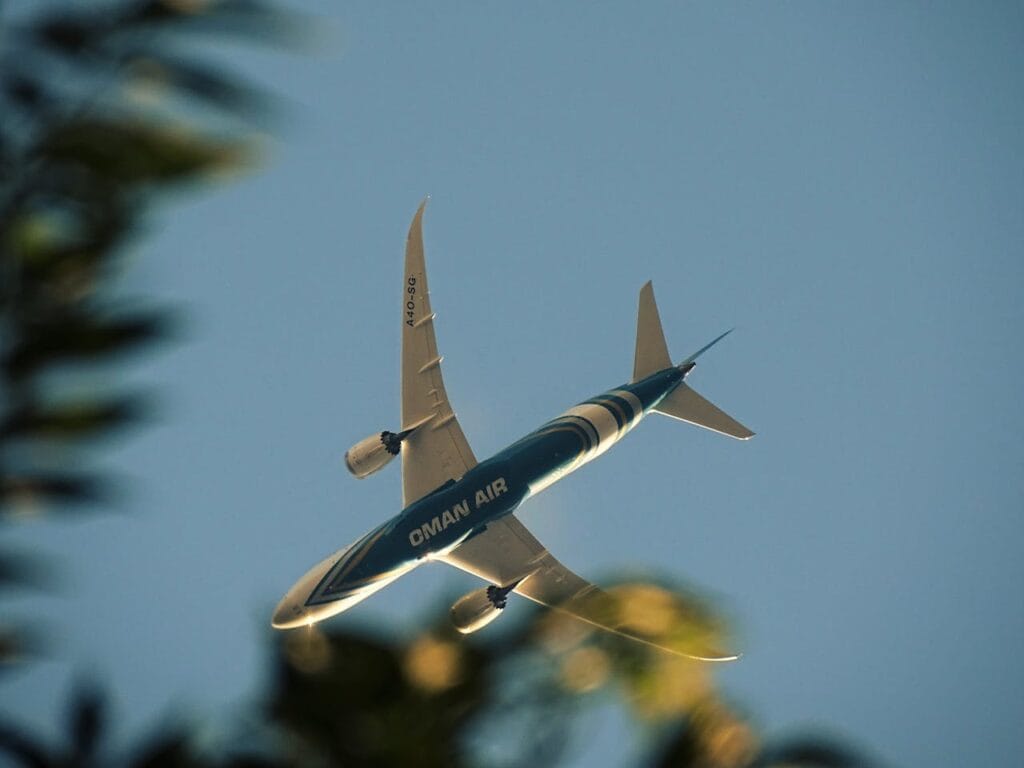
On Saturday morning, US and Israeli forces launched over a hundred strikes across Iran. Khamenei was dead by afternoon. By Sunday, more than 3,400 flights had been cancelled across seven Middle Eastern airports. Dubai International, one of the busiest airports in the world, was closed. A drone strike on Abu Dhabi’s Zayed International Airport killed one person and injured seven. Hundreds of thousands of travellers were stranded as far away as Bali, Brazil and Bangladesh.
Both of these things occupied the same news cycle. Both competed for the same human attention. Both were processed by the same feeds, the same algorithms, the same scrolling fingers.
That is the sentence worth sitting with.

What the Algorithm Does With This
The attention economy does not distinguish between iPhone launches and geopolitical catastrophes. It treats both as content. Both are inputs. Both produce engagement signals. Both get sorted, ranked, and served according to the same underlying logic: what keeps people on the platform longest.
The result is a feed that presents a new MacBook Pro and a missile strike on a civilian airport as consecutive items, separated by a sponsored post and a video of a dog.
This is not a new observation. But this week made it unusually visible because both events were large, both were global in their reach, and both demanded attention simultaneously in a way that made the absurdity of the format impossible to ignore.
A man in Newcastle arrived at the airport on Saturday morning for his Emirates flight to Dubai. It was cancelled. He went back to his family’s house an hour away with no idea when he would be able to travel. In the same news cycle, technology journalists in New York, London and Shanghai were being invited to a Special Apple Experience to get hands-on time with the iPhone 17e and a new low-cost MacBook starting at $599.
Both are real stories. Both deserve coverage. The problem is not that either exists. The problem is the format that presents them as equivalent inputs to be consumed at the same pace with the same level of emotional engagement.

The iPhone 17e and the Hierarchy of Attention
The products Apple is launching this week are genuinely significant by the standards of technology journalism.
TheiPhone 17e brings MagSafe, a newer A19 chip, and Center Stage to Apple’s entry-level phone. The new low-cost MacBook, which Gurman described as the only thing in Apple’s imminent pipeline that actually looks new, comes in bold colours and is positioned as Apple’s most affordable laptop ever, aimed at students and people switching from Windows or Chromebooks. Two new iPads add Apple Intelligence support to models that previously lacked it. The MacBook Pro gets its M5 Pro and M5 Max chips. It is, by any reasonable measure, Apple’s biggest early-year product refresh in recent memory.
Tim Cook planned this week months in advance. The invitations went out. The press events were booked in three cities. The supply chains were prepared. The launch was engineered to capture maximum attention.
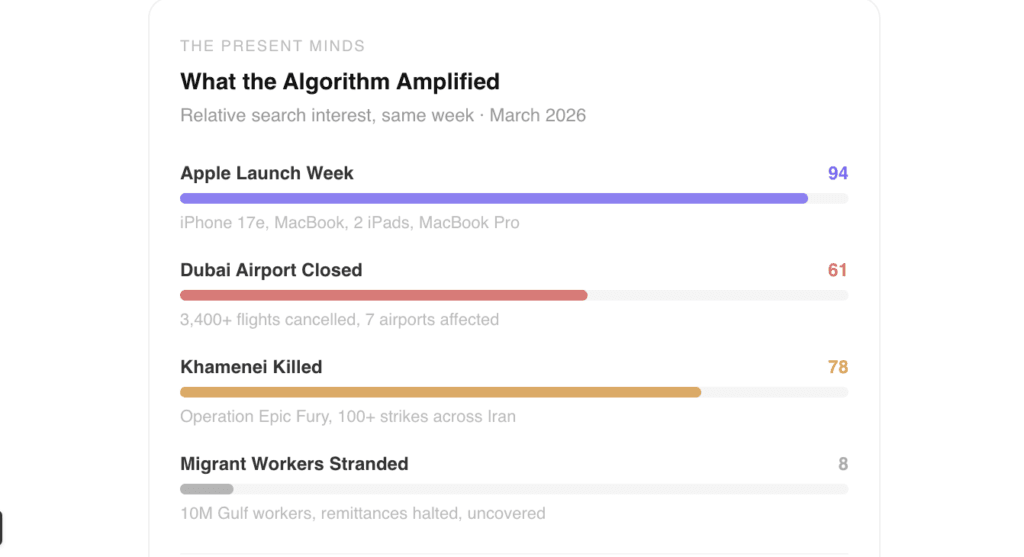
It will still capture enormous attention. Apple’s product launches reliably generate more online engagement than most international news events. The iPhone 17e reveal will produce more search traffic today than the flight cancellations. That is not speculation. It is the predictable output of a media ecosystem that has spent twenty years training its audience to care intensely about consumer technology.
None of that is Tim Cook’s fault. He is running a company. His job is to sell products.
The question is what it means that we have built a world where both the iPhone 17e and the closure of Dubai International Airport compete for the same finite pool of human attention, and where the algorithm that governs that competition was not designed with any concept of hierarchy, proportion or consequence.
The People Nobody Is Writing About
There is a specific population of people this week whose story sits between the two news threads and gets covered by neither.
They are the migrant workers whose flights to the Gulf were cancelled and who do not know how long the disruption will last or whether their jobs will still be there. Mohammad Abdul Mannan was standing in the crowd at Dhaka’s international airport on Sunday. He told reporters he was not concerned about the war. He needed to get his flight to the Middle East to earn a living. My only concern is how to go abroad and how to earn an income, he said.
Approximately 10 million migrant workers from South Asia and Southeast Asia work in the Gulf states. They send remittances home that represent significant portions of their home countries’ economies. When the airports close, their ability to get to work closes with it. Their income stops. Their families’ income stops.
They do not have Apple launch events. They do not have hands-on experiences scheduled in three cities. They have a cancelled flight and a phone line that nobody is answering.
This is the population the attention economy is least designed to surface. Their story lacks the visual appeal of new hardware. It lacks the familiarity of a brand that has trained billions of people to feel something when its logo appears. It is unglamorous, structurally complex, and does not resolve in a news cycle.
It is also, by any reasonable measure, more important than the MacBook Pro.
What the Juxtaposition Reveals
The moral fatigue article on this site describes what happens when people are overexposed to crisis without resolution. They go numb. They disengage. The emotional resources required to care are depleted faster than they can recover.
The attention economy accelerates this process by removing hierarchy. When everything is content, nothing is weighted. The brain cannot maintain appropriate emotional responses to a stream of inputs that presents the geopolitical equivalent of a five-alarm fire and a new laptop as consecutive items requiring the same processing mode.
The result is not that people stop caring about the Middle East because they care about Apple. It is that the format makes it structurally difficult to care about anything with the depth and duration that genuine engagement requires. You scroll past the missile strike on Dubai airport and you scroll past the iPhone 17e reveal and the algorithm serves you both the same way and your nervous system processes both in the same compressed window and moves on.
This is the attention economy news cycle doing exactly what it was designed to do. Maximise time-on-platform. Maximise engagement signals. Minimise friction between inputs.
It was not designed for a week like this one. But it has no mechanism for recognising that a week like this one is different from any other week.

The Tim Cook Problem
Tim Cook did not cause the airstrikes on Iran. He is not responsible for the closure of Dubai International. He planned a product launch and the world scheduled a military operation in the same week without consulting him.
But Tim Cook is also the CEO of a company whose products, whose App Store, whose notification systems and algorithmic feed structures are among the primary infrastructure of the attention economy that makes this juxtaposition possible and normal.
Apple builds the phones that people use to scroll past the missile strikes and the MacBook Pro reveals in the same session. Apple’s platforms carry both. Apple profits from the engagement that both generate.
This is not a reason to not buy the iPhone 17e. It is a reason to think carefully about what the device is part of, what system it participates in, and what that system is doing to the human capacity for proportionate response to the world it presents.
The attention economy news cycle is the water we swim in. This week it was unusually visible. The fish rarely notices the water.
Today it was hard not to.
Read next: Moral Fatigue: Why Good People Stop Caring Online
Why are human babies so helpless at birth?
What is dharma? what the mahabharata knew about losing everything