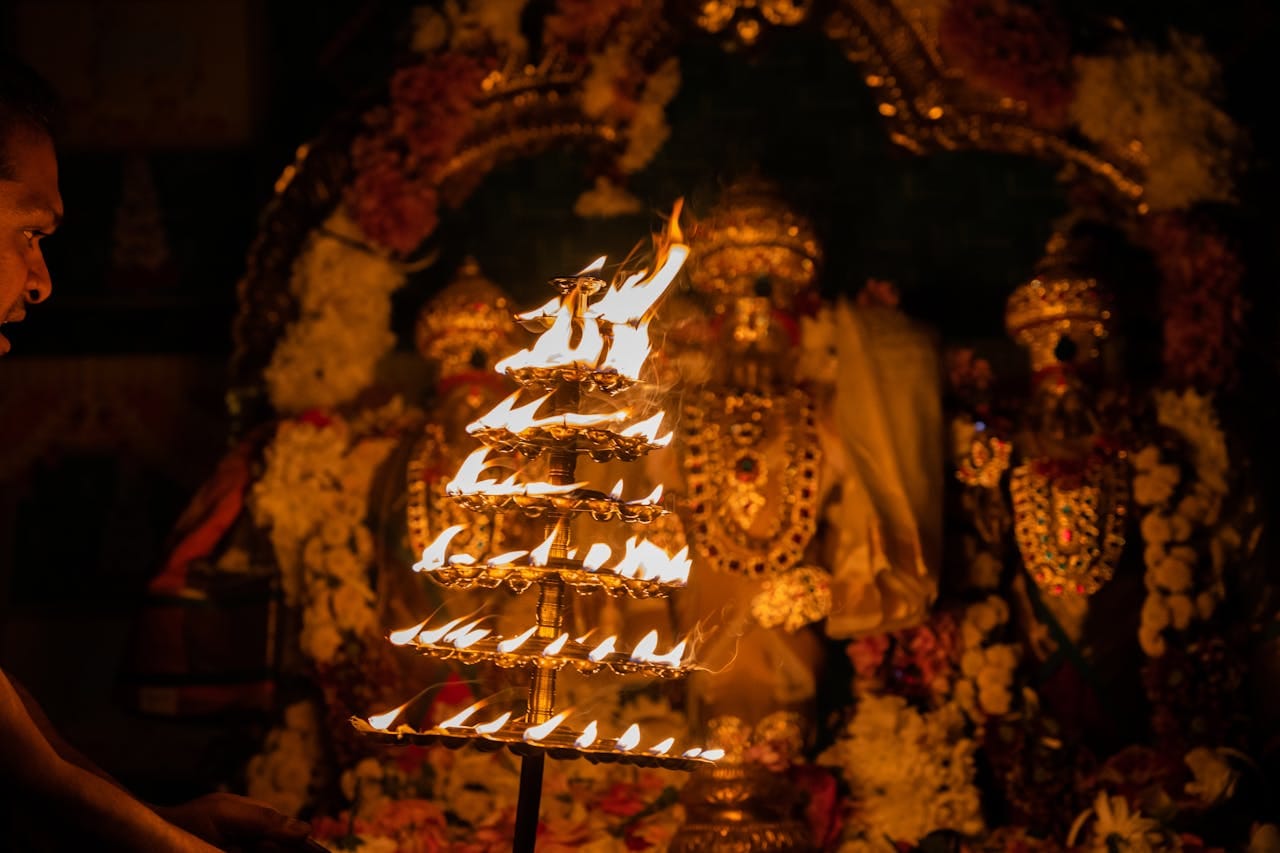
Draupadi’s question in the Mahabharata was not rhetorical.
She needed an answer. She asked it in a room full of the wisest, most senior men in the known world. Men who had spent their lives studying the very frameworks designed to answer it.
Not one of them spoke.
That silence is still one of the most devastating moments in the entire epic. Not because of what it contains. Because of what it refuses to contain.
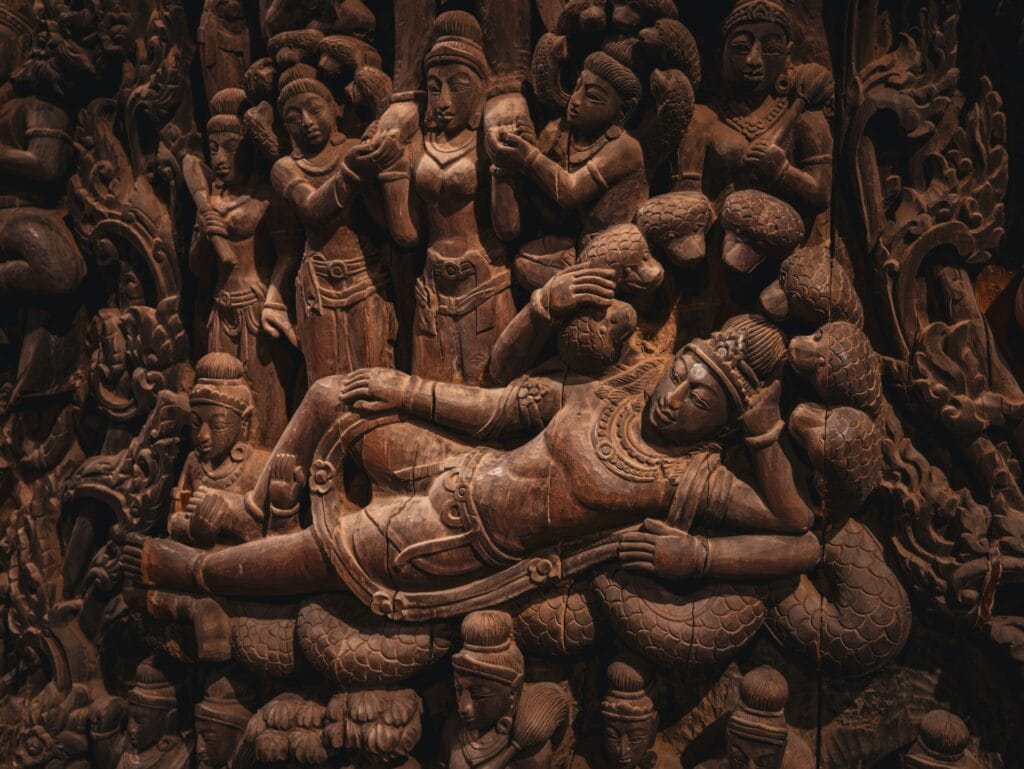
The Game That Was Never Really a Game
Yudhishthira was the eldest Pandava. Just king. Lover of truth. A man whose Dharma was so central to his identity that the tradition called him Dharmaputra. Son of Dharma itself.
He also had a problem with dice.
Shakuni was Duryodhana’s uncle and the finest dice player in the world. His dice were carved from his own father’s bones. He did not lose.
Yudhishthira knew this. The invitation to play was not subtle. The Kauravas wanted the Pandavas’ wealth, their kingdom, their dignity, and they had found the instrument. A game that looked like chance but was not.
Yudhishthira sat down anyway.
He lost his treasury. He staked it back and lost again. He staked his kingdom. Gone. His brothers, one by one, as pieces in a game that had long since stopped being one. Himself. Gone.
Then he staked Draupadi.
She was not in the hall. She was told afterward, by a messenger, that she had been wagered and lost and was now the property of the Kauravas. She was to come immediately.
She sent the messenger back with a question.

Draupadi’s Question in the Mahabharata
The question was precise.
Had Yudhishthira lost himself first, before he staked her? If so, he was already a slave when he made the wager. A slave owns nothing. A slave cannot stake another person because a slave has no standing to make any stake at all.
Or had he staked her first, while he was still a free man? In which case the sequence mattered and the answer was different.
She was not asking out of confusion. She knew exactly what she was asking. She was asking the court to locate the moment in the sequence of wagers where the law failed itself. To find the precise point at which Dharma either held or broke.
The messenger returned to the hall. Repeated the question.
The hall went quiet.
Bhishma was there. Grandfather of both sides. Warrior, scholar, upholder of righteousness. A man who had given up everything for Dharma and had spent his entire life inside its demands. He had an answer for almost everything.
He said he could not answer this.
Drona was there. The greatest teacher of the age. Kripacharya. Vidura, who as we have seen was the wisest counsellor in the court. Senior men, learned men, men whose entire function was to know how these questions resolved.
Nobody spoke.
Dushasana was sent to bring her by force.
What the Silence Meant
The tradition has produced centuries of commentary on this moment. What was Bhishma doing? Was he protecting his position? Was he genuinely uncertain? Was the silence cowardice or was it the honest acknowledgment that the question had no clean answer under the rules as written?
All of those readings exist. The Mahabharata tends to make space for all of them at once.
But the most honest reading is also the simplest.
The question was unanswerable because the system that should have answered it had already been used against her.
Dharma, as the Purusharthas present it, is the first and most fundamental aim. The righteous order. The structure that makes Artha, Kama, and Moksha possible at all. It is the ground rules of a life lived in right relation to the world.
What Draupadi’s question exposed was that Dharma had been operating that day with a blind spot built in. The rules of the game permitted Yudhishthira to stake everything he possessed. The rules defined a wife as something a man could possess. The rules said a wager made in a legal game was binding.
Each rule, in isolation, held.
Together, they produced a conclusion that every person in that hall understood was wrong.
The silence of the wise is not always ignorance. Sometimes it is the sound of a framework discovering its own edge.
The Particular Quality of Draupadi’s Mind
She had been dragged in by her hair. She was in a state of partial undress. She was surrounded by men who had just watched her husband lose her in a game.
She asked a philosophical question.
Not a plea. Not a curse, though curses would come later, and they would hold. A clean, structural question about the sequence of events and the legal standing of the man who had staked her.
This is significant because it shows something the Mahabharata returns to repeatedly but rarely names directly. Draupadi was not asking to be saved by emotion. She was asking the court to do its job. To apply to her case the same rigorous reasoning it applied to everything else.
She was making a legal argument in a room that had agreed, collectively, to stop making legal arguments the moment doing so would inconvenience the powerful.
The question went unanswered not because it was unanswerable in principle. It went unanswered because answering it correctly would have required the court to acknowledge what it had just permitted.
Where Dharma Breaks
The Purusharthas do not present Dharma as infallible. This is one of the things that separates the Mahabharata from simpler moral texts.
The Bhagavad Gita famously takes place on a battlefield where Dharma is in direct conflict with itself. A man’s duty to his family against his duty to righteousness. His duty to his teacher against his duty to the truth. The text does not resolve this by declaring one Dharma correct. It asks what a person does when the rules run into each other.
Draupadi’s question is a different version of the same problem.
She is not asking which of two dharmas wins. She is pointing at a moment when the framework, applied correctly, arrives at a clearly unjust conclusion. And asking the room to notice.
The room noticed. That much is clear from the silence. A room that had not noticed would have had an immediate answer, however wrong.
What the room could not do was take the next step. To say: the framework has produced an injustice. The framework therefore needs to account for this.
That step requires something most institutions across every era have found extraordinarily difficult.
It requires acknowledging that the rules you have organised your authority around are not sufficient.
What Happened Next and What It Cost
Krishna arrived, eventually, and clothed Draupadi when Dushasana tried to strip her. That moment belongs to a different part of the story.
What happened first was that she received nothing from the court. No answer. No protection. No acknowledgment that the question she had asked deserved the engagement it had earned.
She was a queen. She was a woman of extraordinary intelligence, asking with complete precision for the legal system of her world to apply its own logic honestly.
And the most powerful men of the age looked at the question, understood it, and found that speaking required more than they were able to offer.
She was not wrong about what that silence meant. She never forgot it. Her specific unforgetting of it runs like a low current through the rest of the Mahabharata, shaping choices and keeping the war inevitable in ways the text tracks carefully.
A wrong that is witnessed and not named does not go away. It waits.
What the Mahabharata Is Actually Teaching Here
Dharma without accountability is not Dharma.
That is the lesson the dice hall teaches. Not that the rules are bad. Not that Yudhishthira should not have sat down, though he should not have. Not even, precisely, that the Kauravas were villains, though what they did was villainous.
The specific lesson is about the room.
Bhishma, Drona, Vidura, Kripacharya. Men who knew. Men whose entire identity was built around knowing. Men who had the standing, the authority, the institutional weight to speak.
Their silence did not keep them neutral. In a room where an injustice is happening, silence is a position. It just happens to be the most comfortable one available.
The Purusharthas present Dharma as the first aim because without it the others cannot hold. Artha becomes extraction. Kama becomes exploitation. The whole structure depends on the first layer being honest.
Draupadi’s question was asking the room to be honest.
The room decided it had other priorities.
The war that followed killed almost everyone in it.
The Mahabharata notes this without comment, which is its preferred way of making the most important points.
Read Next: What the Mahabharatha knew about wealth that nobody told you
Why Nothing Feels Real Anymore: the strange experience nobody talks about
What we inherit from our parents (it is more than you think)
 Psychology · Sep 22, 2026Chimpanzees Have Accents. They Grow into Them.
 The Margin · Sep 17, 2026People Are Seeing Ads in Their Dreams.
 Slow Meridian · Sep 16, 2026Autumn Leaves