Bhishma did not die when the arrows hit him. he chose when.

Some links on this page may be affiliate links. If you purchase through them, we may earn a commission at no extra cost to you.
KEY TAKEAWAYS
  • Bhishma possessed the boon of ichcha mrityu, allowing him to choose the moment of his death, reflecting a profound control over life and duty.
  • His vow to renounce the throne and progeny was a pivotal sacrifice that shaped the course of the Mahabharata's events.
  • Even while gravely wounded, Bhishma prioritized teaching and guidance over his own suffering, exemplifying duty beyond personal pain.
  • Bhishma's death was deliberate and symbolic, timed with Uttarayana to signify completion and readiness rather than defeat.
  • The ancient concept of ichcha mrityu parallels modern legal recognition of the right to die with dignity, emphasizing autonomy in death.
GLOSSARY
Ichcha Mrityu
A boon meaning 'death by one's own will,' granting Bhishma the power to choose the timing of his death rather than dying involuntarily.
Bhishma
Originally named Devavrata, a key figure in the Mahabharata who took a vow of celibacy and renounced his claim to the throne, embodying sacrifice and duty.
Uttarayana
The northward passage of the sun, symbolizing light and auspiciousness, marking the moment Bhishma chose to relinquish his life.
Shanti Parva
A section of the Mahabharata where Bhishma imparts teachings on governance, duty, and peace while lying on his bed of arrows.
Kurukshetra
The battlefield where the great war of the Mahabharata took place, and where Bhishma was grievously wounded but did not die immediately.
The Vow
Bhishma's solemn promise to never marry or father children, ensuring the throne would pass to Satyavati's descendants.
FAQ
What is the significance of Bhishma's boon of ichcha mrityu?
Ichcha mrityu granted Bhishma the unique ability to choose the moment of his death, symbolizing ultimate control over life and duty. It allowed him to endure pain and fulfill his responsibilities before passing away on his own terms.
Why did Bhishma renounce his claim to the throne and vow celibacy?
Bhishma renounced his birthright and vowed never to marry or have children to ensure that the throne would pass to Satyavati's descendants without dispute. This vow was a sacrifice made to uphold his father's promise and maintain peace in the kingdom.
How did Bhishma continue to influence the war aftermath despite being wounded?
While lying on a bed of arrows, Bhishma taught Yudhishthira about governance, duty, and peace, producing the Shanti Parva. His teachings provided guidance for ruling and moral conduct even after the war had ended.
What does Bhishma's choice to die during Uttarayana symbolize?
Dying during Uttarayana, the auspicious northward movement of the sun, symbolizes Bhishma's readiness and the completion of his life's duties. It reflects a deliberate and meaningful departure aligned with cosmic order.
How does the concept of ichcha mrityu relate to modern legal ideas about death?
Ichcha mrityu parallels the modern legal recognition of the right to die with dignity, as seen in India's 2026 ruling on passive euthanasia. Both emphasize the individual's autonomy to decide when and how to end life after fulfilling their responsibilities.
EDITORIAL NOTE
This piece is part of The Present Minds — essays on psychology, identity, and modern life.
Posted

in

by

Comments

Leave a Reply

Your email address will not be published. Required fields are marked *

The Present Minds
By Navneet Shukla April 7, 2026 Purusharth

Bhishma did not die when the arrows hit him. he chose when.

5 min read · 953 words
Tap to switch read mode. Original contrast is live.
Navneet Shukla
Written By Navneet Shukla Founder · Editor · Systems Architect

Navneet Shukla writes about how people think and how modern life shapes that thinking. The Present Minds is where he explores it.

Bhishma fell on the tenth day of the war. He did not die.

The arrows had entered him from every direction. He lost consciousness briefly when he struck the shafts. When he came back to himself, held above the ground by the arrows beneath him, he understood what had happened.

He had not been taken. He had been given a choice.

The boon he held was called Ichcha mrityu. The meaning, in Sanskrit, is precise: death by one’s own will. Not suicide. Not surrender. The freedom to leave the body at a moment of one’s own choosing, when the work is done and not before.

He had carried ichcha mrityu for decades. On the tenth day of Kurukshetra, he finally had reason to use it.

He chose not to. Not yet.

 ichcha mrityu meaning

The Vow That Started Everything

Bhishma was born Devavrata. Son of King Shantanu and the river goddess Ganga. By birth, he was heir to the throne of Hastinapura.

He gave it away before he used it.

His father fell in love with a fisherman’s daughter named Satyavati. The fisherman had one condition: not Devavrata’s children, but Satyavati’s, would inherit the kingdom. Devavrata agreed without hesitation. Then, because the fisherman still worried about future disputes, Devavrata went further. He swore before the full court that he would never marry and never father children. No descendant of his blood would contest anything, ever.

The court named him Bhishma for it. The one who took the terrible vow.

His father, undone by what his son had surrendered, offered him whatever he wished. Devavrata asked for one thing: that death would come only when he permitted it. That he would hold ichcha mrityu for as long as he lived.

He carried it through a life longer than most men in that world ever saw. Through courts and alliances and the slow unraveling of every kingdom he had served. Long enough to watch every consequence arrive.

A boon is not always a gift. Sometimes it is a longer sentence.

ichcha mrityu

What He Asked for as a Pillow

When Bhishma fell at Kurukshetra, Duryodhana’s physicians arrived quickly. He thanked them and sent them away.

He asked for a pillow. The kings around him brought silk cushions, fine cloth. He refused each one.

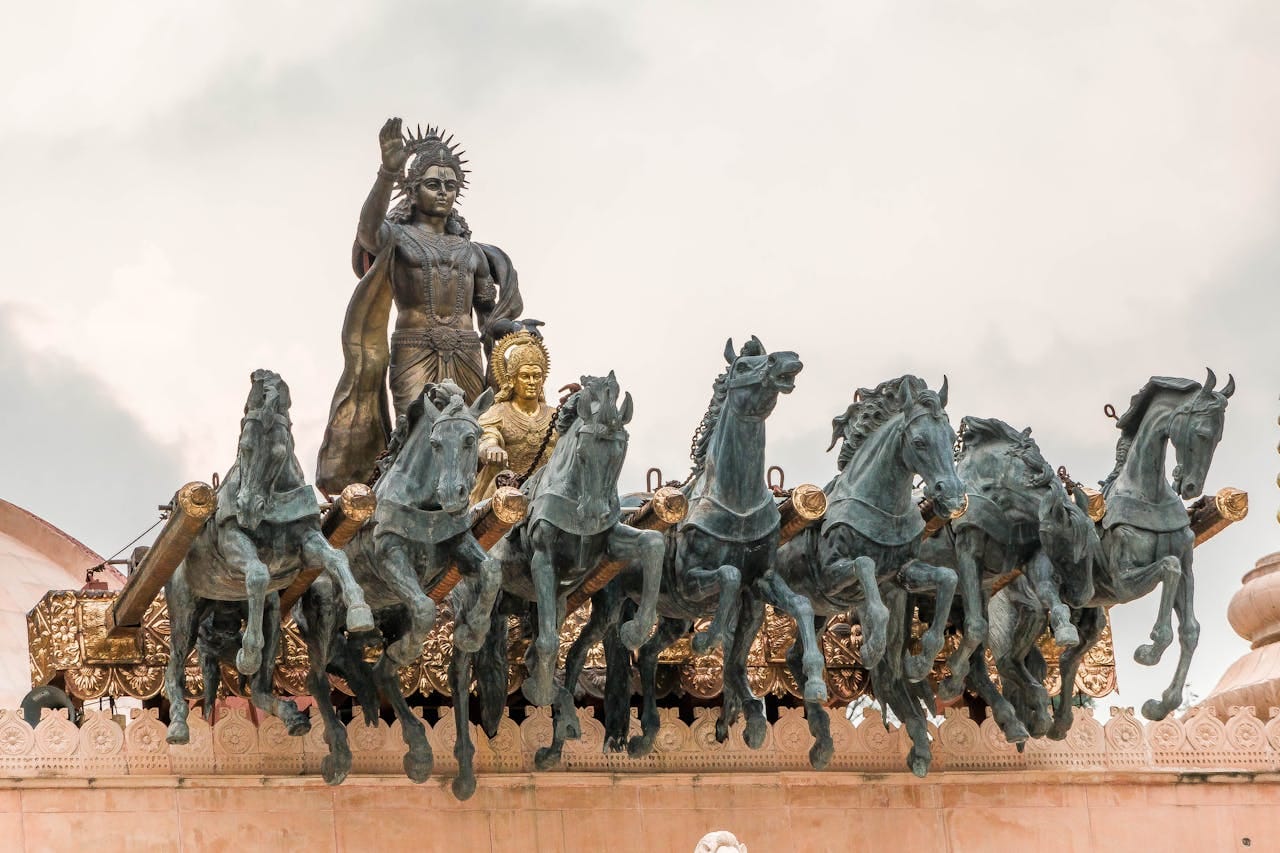
Arjuna came forward. He drew three arrows from his quiver and drove them into the earth beside Bhishma’s head, angled upward, to cradle his neck.

Bhishma settled against them and looked at the sky.

The Mahabharata does not explain this detail. It records it and trusts the reader. A man holding ichcha mrityu, who could have asked for anything, chose the plain gesture of the person who felled him. Not softness. Not bitterness. The true thing, even when it is made of iron.

Bhishma Mahabharata

The Teaching From the Ground

He was in pain. The text says so plainly.

He lay on the arrows and taught.

Yudhishthira came to him after the war ended. The new king, who had won something he had not wanted, and inherited a throne soaked in the deaths of everyone he had grown up beside. He came with questions. How to rule. What power owes the people beneath it. Whether a man can govern with any decency when he came to governance through catastrophe.

Bhishma answered every question. What became the Shanti Parva, the Book of Peace, poured out of him from the ground at Kurukshetra. It is one of the longest sections in the entire epic. He produced it from a position most men could not have spoken a sentence from.

The man who keeps teaching from a bed of arrows is not performing endurance. He simply has more left to say.

right to die with dignity

Ichcha Mrityu and the Moment He Used It

Bhishma was waiting for the sun.

Uttarayana: the northward passage, the half of the year when light returns rather than retreats. He had lived with precision. He intended to end with it.

He had the ichcha mrityu boon and had not wasted it. He had not used it to escape the battle. He had not used it to escape the pain. He used it for the one thing it was actually for: to leave when nothing was left undone.

When Uttarayana arrived, he stopped. The Mahabharata describes it the way it reserves for things it considers significant: quietly. He withdrew from his body with the ease of a man setting something down he had carried a long time. The warriors around him saw his eyes go still.

Then he was gone.

No final declaration. He had said everything that needed saying from the arrow-bed. He had meant for it to end there, and it did.

passive euthanasia India

What He Was Waiting For

He could have died on the battlefield. The arrows had done the work. Nobody would have questioned it.

But he had questions left to answer. A king to steady. A teaching not yet spoken. So he stayed, in pain, for fifty-eight days, and finished. When he was finished, he left. Quietly. On time. In the light he had waited for.

In March 2026, an Indian court invoked ichcha mrityu to grant passive euthanasia for the first time in the country’s legal history. The right to die with dignity, the bench ruled, belongs to the person dying. The concept they reached for was already three thousand years old.

Ichcha mrityu, in the Mahabharata’s telling, is not the right to escape. It is the right to be finished before you go.

Bhishma was finished. So he went.

Still. Already. Entirely on his own terms.

Read Next: What the Mahabharata knew about being right and being ignored

What the Mahabharatha knew about wealth that nobody told you

Yoga Kshema Meaning: the bhagavad gita verse nobody finishes reading

Navneet Shukla
Written By

Navneet Shukla

Founder · Editor · Systems Architect

Navneet Shukla writes about how people think and how modern life shapes that thinking. The Present Minds is where he explores it.

Key Takeaways
  • Bhishma possessed the boon of ichcha mrityu, allowing him to choose the moment of his death, reflecting a profound control over life and duty.
  • His vow to renounce the throne and progeny was a pivotal sacrifice that shaped the course of the Mahabharata's events.
  • Even while gravely wounded, Bhishma prioritized teaching and guidance over his own suffering, exemplifying duty beyond personal pain.
  • Bhishma's death was deliberate and symbolic, timed with Uttarayana to signify completion and readiness rather than defeat.
  • The ancient concept of ichcha mrityu parallels modern legal recognition of the right to die with dignity, emphasizing autonomy in death.
Glossary
Ichcha Mrityu
A boon meaning 'death by one's own will,' granting Bhishma the power to choose the timing of his death rather than dying involuntarily.
Bhishma
Originally named Devavrata, a key figure in the Mahabharata who took a vow of celibacy and renounced his claim to the throne, embodying sacrifice and duty.
Uttarayana
The northward passage of the sun, symbolizing light and auspiciousness, marking the moment Bhishma chose to relinquish his life.
Shanti Parva
A section of the Mahabharata where Bhishma imparts teachings on governance, duty, and peace while lying on his bed of arrows.
Kurukshetra
The battlefield where the great war of the Mahabharata took place, and where Bhishma was grievously wounded but did not die immediately.
The Vow
Bhishma's solemn promise to never marry or father children, ensuring the throne would pass to Satyavati's descendants.
FAQ
What is the significance of Bhishma's boon of ichcha mrityu?
Ichcha mrityu granted Bhishma the unique ability to choose the moment of his death, symbolizing ultimate control over life and duty. It allowed him to endure pain and fulfill his responsibilities before passing away on his own terms.
Why did Bhishma renounce his claim to the throne and vow celibacy?
Bhishma renounced his birthright and vowed never to marry or have children to ensure that the throne would pass to Satyavati's descendants without dispute. This vow was a sacrifice made to uphold his father's promise and maintain peace in the kingdom.
How did Bhishma continue to influence the war aftermath despite being wounded?
While lying on a bed of arrows, Bhishma taught Yudhishthira about governance, duty, and peace, producing the Shanti Parva. His teachings provided guidance for ruling and moral conduct even after the war had ended.
What does Bhishma's choice to die during Uttarayana symbolize?
Dying during Uttarayana, the auspicious northward movement of the sun, symbolizes Bhishma's readiness and the completion of his life's duties. It reflects a deliberate and meaningful departure aligned with cosmic order.
How does the concept of ichcha mrityu relate to modern legal ideas about death?
Ichcha mrityu parallels the modern legal recognition of the right to die with dignity, as seen in India's 2026 ruling on passive euthanasia. Both emphasize the individual's autonomy to decide when and how to end life after fulfilling their responsibilities.
Editorial Note

This piece is part of The Present Minds, essays on psychology, identity, and modern life.
Discussion
No comments yet. Be the first.