Therapy generation anxiety: the paradox nobody wants to admit
Some links on this page may be affiliate links. If you purchase through them, we may earn a commission at no extra cost to you.
Written by
The Present Minds
Administrator
A digital sanctuary for the overstimulated.
Clarity. Depth. Silence.
KEY TAKEAWAYS
Generation Z is the most therapised yet also the most anxious and depressed generation, raising questions about the relationship between therapy and mental health outcomes.
Therapy originally aimed for crisis intervention and resolution but has culturally shifted toward indefinite, inward-focused treatment without guaranteed improvement.
Excessive rumination, often encouraged by some therapy approaches, can worsen depression and anxiety rather than alleviate it.
The widespread adoption of mental health language has expanded awareness but may also increase the perception or presence of suffering.
Evidence supports finite, action-oriented therapies like CBT and Behavioral Activation over open-ended, retrospective therapy dominant in culture.
GLOSSARY
Therapy generation anxiety
The paradox of Generation Z being both the most engaged with therapy and the most anxious and depressed generation.
Rumination
Repetitive focus on negative experiences and feelings, which can causally increase depression and anxiety.
Iatrogenic effects
Harm caused by the treatment itself, such as certain therapeutic techniques worsening mental health.
Mental health language
Clinical terms like trauma, triggers, and narcissism that have become common in everyday use, sometimes imprecisely.
Cognitive Behavioural Therapy (CBT)
A therapy modality with strong evidence that focuses on changing behavior and thought patterns to improve mental health.
Behavioral Activation
A therapy approach emphasizing engagement with the world and action rather than self-examination, effective for depression.
FAQ
Why is Generation Z considered the most anxious and depressed despite increased therapy use?
While therapy use has increased and stigma decreased, mental health outcomes have worsened. This paradox may relate to how therapy is practiced culturally, with some approaches potentially encouraging rumination rather than resolution.
How has the cultural role of therapy changed from its original purpose?
Therapy was originally designed as a finite intervention to resolve specific crises. Today, many young people engage in ongoing, indefinite therapy focused on self-examination rather than behavioral change or resolution.
What is rumination and how does it affect mental health?
Rumination is the repetitive focus on negative feelings and experiences. It is both a cause and consequence of depression, and therapy that encourages excessive rumination can worsen symptoms.
How has the spread of mental health language impacted young people?
The widespread use of clinical terms in everyday life has increased awareness and the ability to identify psychological harm, but it may also broaden what is perceived as suffering, complicating the experience of mental health.
What types of therapy have the strongest evidence for effectiveness?
Therapies like Cognitive Behavioural Therapy, Behavioral Activation, and Exposure Therapy have robust evidence. They focus on finite treatment courses and outward behavioral change rather than indefinite introspection.
EDITORIAL NOTE
This piece is part of The Present Minds — essays on psychology, identity, and modern life.
Therapy generation anxiety: the paradox nobody wants to admit
7 min read · 1,315 words
Therapy generation anxiety is the paradox nobody in the mental health industry wants to talk about.
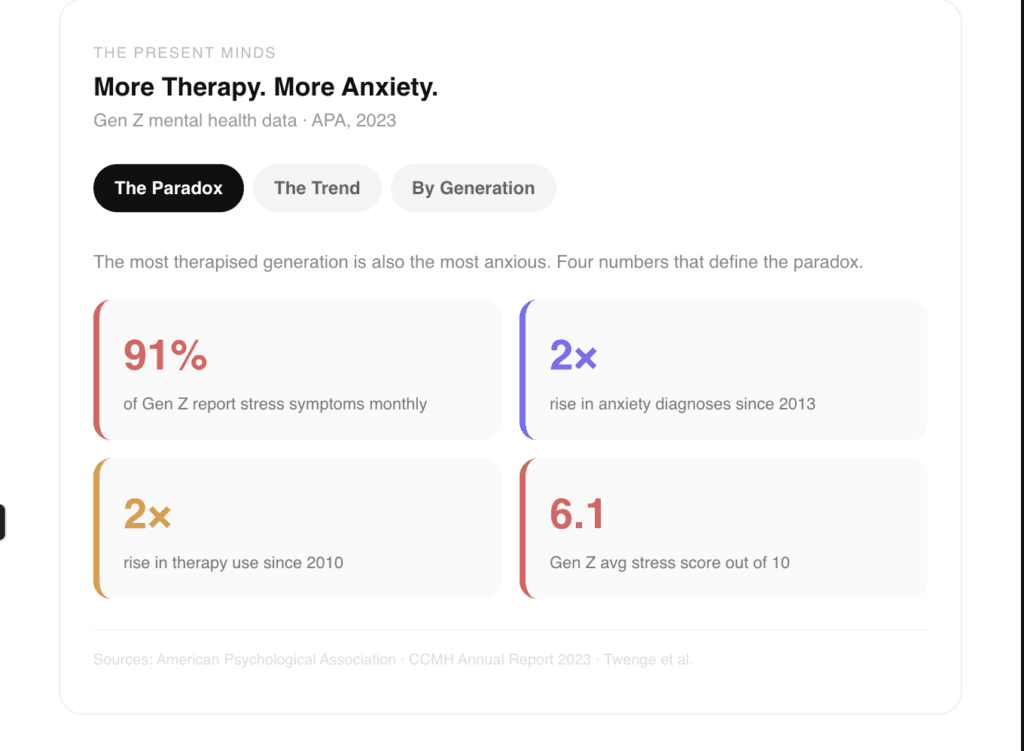
Generation Z is the most therapised generation in history. More young people are in therapy, talking about their feelings, using mental health language, and identifying their emotional states than at any previous point in recorded human history. The stigma around seeking help has collapsed. The conversation has been normalised. The infrastructure has expanded.
And Generation Z is also, by every available measure, the most anxious, most depressed, and most mentally unwell generation ever studied.
Both of these things are true simultaneously. And the question that follows, the one that makes therapists uncomfortable and wellness influencers go quiet, is whether they are related.
The American Psychological Association’s 2023 Stress in America survey found that Gen Z adults reported the highest average stress levels of any generation, higher than millennials, higher than Gen X, higher than baby boomers. Ninety-one percent of Gen Z reported experiencing at least one physical or emotional symptom of stress in the past month.
These trends moved in the same direction at the same time. Therapy became more available and more normalised. Mental health outcomes got worse. The correlation is uncomfortable and does not by itself prove causation.
But it is a question that deserves an honest answer rather than a defensive one.
What Therapy Was Designed to Do
The original logic of talk therapy was crisis intervention. A person was suffering. The suffering was interfering with their life. A therapist helped them understand what was causing it and develop tools to address it. The course of treatment was finite. The goal was resolution.
That is not how therapy has come to function culturally for a significant portion of young people today.
For many, therapy has become a permanent feature of life rather than a response to a specific problem. A weekly appointment that continues indefinitely. A primary relationship for processing experience. A framework through which all of life is interpreted.
Lori Gottlieb, a therapist and the author of Maybe You Should Talk to Someone, has written honestly about the tension she sees in her own practice. Clients who have been in therapy for years, who are fluent in the language of trauma and attachment and nervous system regulation, who can identify their triggers with precision, and who are not meaningfully better than when they started.
She is not alone in noticing this. Scott Lilienfeld, a clinical psychologist and researcher, spent years documenting what he called psychological treatments that potentially harm. Some widely used therapeutic techniques, including certain forms of trauma-focused treatment applied indiscriminately, produce measurable worsening in some populations. The mental health field has been slower than medicine to systematically track iatrogenic effects, harms caused by the treatment itself.
The Rumination Problem
Here is where the research gets pointed.
Rumination is the clinical term for repetitively focusing on negative experiences, feelings and their causes. It is one of the strongest predictors of depression. People who ruminate extensively, who replay painful events, who analyse their suffering at length, experience more depression, not less. The relationship is causal in both directions: depression causes rumination, and rumination causes depression.
Therapy, done well, reduces rumination. It gives people tools to interrupt and redirect the loop.
But therapy, done poorly, or in certain formats, or with a therapist who encourages extended re-examination without resolution, can amplify it. The act of talking about your problems for an hour every week, of revisiting painful experiences repeatedly without processing them toward resolution, can look like therapeutic work while functioning as structured rumination.
The distinction matters and it is not always made clearly.
A 2024 meta-analysis of mindfulness-based interventions found that for people with high baseline anxiety, certain forms of extended self-focused attention produced worse outcomes than control conditions. The same attention that heals in the right context harms in the wrong one.
The Language That Shapes the World
There is something else happening alongside the clinical picture that is harder to measure and may be more consequential.
The vocabulary of mental health has entered everyday life at a scale and speed that the field was not prepared for.
Trauma. Triggers. Gaslighting. Narcissism. Boundaries. Nervous system dysregulation. These are clinical terms with specific technical meanings that have been flattened, broadened and deployed in contexts that stretch far beyond their original scope.
A person who makes you feel guilty is now a narcissist. A conversation that is challenging is now a trigger. A difficult childhood experience is now a trauma. The language is not wrong, exactly. It is imprecise in ways that have real effects.
Jean Twenge, the social psychologist whose research tracks generational shifts in mental health, and Jonathan Haidt, whose book The Anxious Generation made the argument about smartphones and social media in detail, both note that the expansion of mental health language correlates with an expansion of what young people experience as threatening or harmful. When the vocabulary for psychological harm becomes more granular and more available, people’s capacity to identify and report that harm expands accordingly.
This is not purely good. It is not purely bad. It is complex in exactly the way that a generation taught to discuss its own psychology at length would be well-equipped to examine.
But it raises a question that is genuinely difficult: does having more precise language for suffering make suffering more visible, or does it make suffering more present?
What Actually Works
None of this is an argument against therapy. It is an argument for precision about what therapy works, for whom, under what conditions.
The evidence base for specific therapeutic modalities is strong. Cognitive Behavioural Therapy has the most robust evidence base of any psychological intervention. Behavioural Activation, which moves the locus of intervention from self-examination to action and engagement with the world, has strong evidence for depression particularly. Exposure therapy for anxiety disorders is among the most effective treatments in all of medicine.
What these approaches share is a finite arc and an outward orientation. They are not primarily about understanding your past. They are about changing your behaviour in the present. The goal is graduation, not indefinite attendance.
The version of therapy that the research supports most strongly is not the version that has become culturally dominant. The culturally dominant version is open-ended, retrospective, and fundamentally inward-looking. That is not a description of bad therapy. It is a description of a therapeutic culture that has drifted from its own evidence base.
The Uncomfortable Middle
The honest position here is not that therapy is bad. It is that therapy, like any powerful intervention, can cause harm as well as healing, and that the mental health field has been less rigorous than it should be about tracking the difference.
It is that a generation raised to examine their inner lives with extraordinary granularity has not necessarily been served by that emphasis alone. That self-knowledge without the capacity to act, to tolerate discomfort, to move through difficulty rather than endlessly processing it, is incomplete.
Paul Bloom, the psychologist and author of The Sweet Spot, makes the case that a certain amount of chosen discomfort and challenge is not incidental to wellbeing but constitutive of it. That meaning comes from doing hard things, not from understanding why hard things are hard.
The therapy generation has been given extraordinary tools for understanding itself. The question is whether understanding is enough, or whether the goal was always to understand enough to act.
The most anxious generation in recorded history is also the most self-aware. Those two facts are in conversation. The field that produced them might consider having that conversation more openly.
Some links on this page may be affiliate links. If you purchase through them, we may earn a commission at no extra cost to you.
Written by
The Present Minds
Administrator
A digital sanctuary for the overstimulated.
Clarity. Depth. Silence.
KEY TAKEAWAYS
Generation Z is the most therapised yet also the most anxious and depressed generation, raising questions about the relationship between therapy and mental health outcomes.
Therapy originally aimed for crisis intervention and resolution but has culturally shifted toward indefinite, inward-focused treatment without guaranteed improvement.
Excessive rumination, often encouraged by some therapy approaches, can worsen depression and anxiety rather than alleviate it.
The widespread adoption of mental health language has expanded awareness but may also increase the perception or presence of suffering.
Evidence supports finite, action-oriented therapies like CBT and Behavioral Activation over open-ended, retrospective therapy dominant in culture.
GLOSSARY
Therapy generation anxiety
The paradox of Generation Z being both the most engaged with therapy and the most anxious and depressed generation.
Rumination
Repetitive focus on negative experiences and feelings, which can causally increase depression and anxiety.
Iatrogenic effects
Harm caused by the treatment itself, such as certain therapeutic techniques worsening mental health.
Mental health language
Clinical terms like trauma, triggers, and narcissism that have become common in everyday use, sometimes imprecisely.
Cognitive Behavioural Therapy (CBT)
A therapy modality with strong evidence that focuses on changing behavior and thought patterns to improve mental health.
Behavioral Activation
A therapy approach emphasizing engagement with the world and action rather than self-examination, effective for depression.
FAQ
Why is Generation Z considered the most anxious and depressed despite increased therapy use?
While therapy use has increased and stigma decreased, mental health outcomes have worsened. This paradox may relate to how therapy is practiced culturally, with some approaches potentially encouraging rumination rather than resolution.
How has the cultural role of therapy changed from its original purpose?
Therapy was originally designed as a finite intervention to resolve specific crises. Today, many young people engage in ongoing, indefinite therapy focused on self-examination rather than behavioral change or resolution.
What is rumination and how does it affect mental health?
Rumination is the repetitive focus on negative feelings and experiences. It is both a cause and consequence of depression, and therapy that encourages excessive rumination can worsen symptoms.
How has the spread of mental health language impacted young people?
The widespread use of clinical terms in everyday life has increased awareness and the ability to identify psychological harm, but it may also broaden what is perceived as suffering, complicating the experience of mental health.
What types of therapy have the strongest evidence for effectiveness?
Therapies like Cognitive Behavioural Therapy, Behavioral Activation, and Exposure Therapy have robust evidence. They focus on finite treatment courses and outward behavioral change rather than indefinite introspection.
EDITORIAL NOTE
This piece is part of The Present Minds — essays on psychology, identity, and modern life.










Leave a Reply