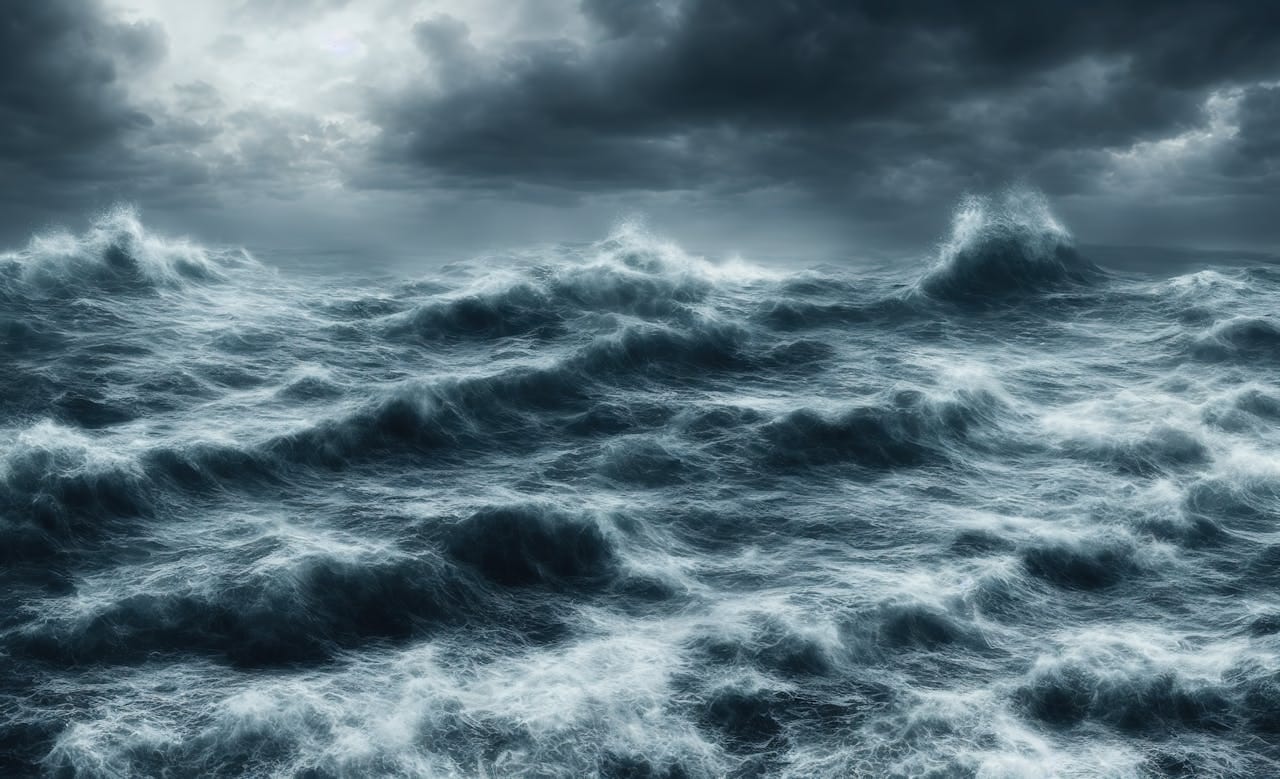
The universal flood myth is one of the most documented phenomena in the study of human culture. Over 200 distinct flood narratives exist across world religions and civilisations from ancient Mesopotamia and Hindu scripture to Aboriginal Australian oral traditions and Native American legend.
These cultures had no contact with each other when their stories formed. Yet the core narrative is almost identical in every version: humanity grows corrupt, a god or gods decide to destroy the world with a flood, a small group of chosen survivors escape on a boat, and from them, civilisation is rebuilt.
That kind of convergence does not happen by accident. So what is actually going on?

The Same Story, Across Every Culture
The oldest written flood story comes from the Epic of Gilgamesh, recorded on clay tablets in ancient Mesopotamia around 2100 BCE. It predates the biblical account of Noah by centuries, yet the two stories share striking structural similarities: divine warning, an ark, the preservation of animals, the release of birds to find dry land.
In Hindu scripture, the Shatapatha Brahmana tells of Manu, a righteous man warned by Vishnu in the form of a fish that a great flood was coming. He built a boat, survived the deluge, and repopulated the earth.
In Greek mythology, Zeus floods the world out of anger at human wickedness, and only Deucalion and Pyrrha survive. In Norse tradition, the slaying of the giant Ymir floods the world in blood, leaving only two survivors to rebuild.
Across more than 70 Native American tribes, flood myths existed before any contact with European missionaries. Aboriginal Australians carry flood stories in their Dreamtime traditions.
Flood narratives appear in Chinese mythology, Zoroastrian texts, the Quran, and in the oral traditions of Southeast Asian communities where researchers have collected over 300 variations of essentially the same story.
The universal flood myth is not a coincidence of culture. Something deeper is happening here.
Three Theories That Try to Explain It
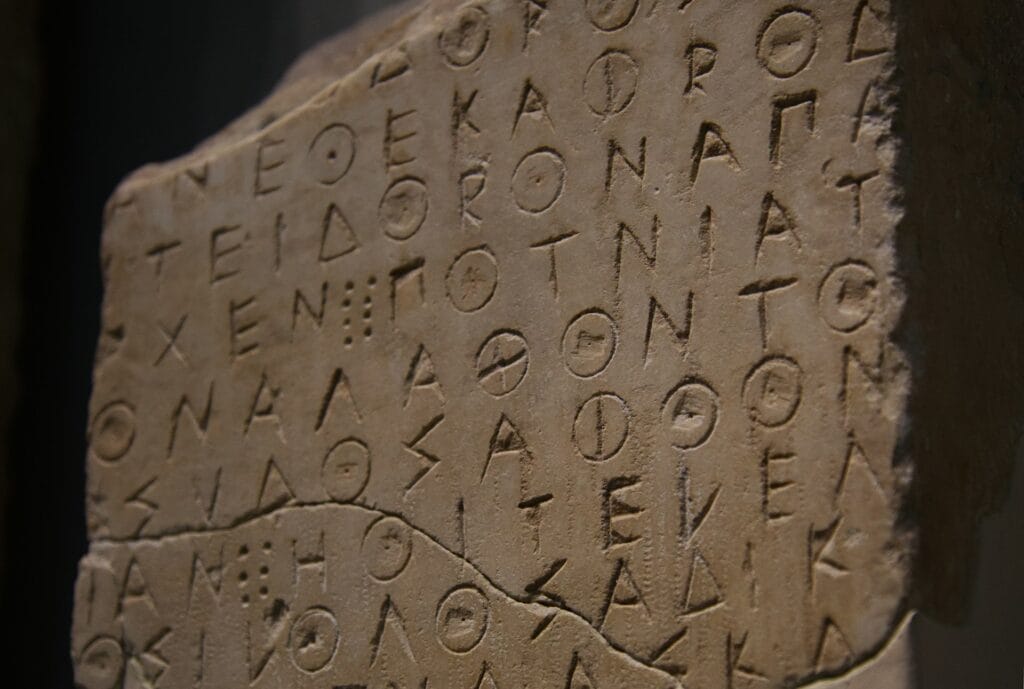
Scholars have debated the origins of the universal flood myth for over a century. Three main theories have emerged.
The first is cultural diffusion: the story began in one place, most likely Mesopotamia, and spread outward through trade, migration, and conquest. This explains the similarities between Sumerian, Hebrew, and Greek versions well. But it breaks down completely when accounting for isolated cultures in the Americas, Pacific Islands, and Australia, where no such contact existed.
The second is psychological universalism. Carl Jung argued that certain stories arise independently across cultures because they tap into universal archetypes embedded in human psychology.
Water represents the unconscious. The flood represents chaos and destruction. The survivor represents hope and renewal. On this reading, the myth does not need a shared historical origin because it emerges naturally from the structure of the human mind.
The third theory is the most literal: something actually happened. A real catastrophic event, experienced by a population that then scattered across the world, carrying the memory of it with them in their stories.

The Black Sea Flood Hypothesis
In 1997, geologists William Ryan and Walter Pitman from Columbia University proposed a candidate event. Around 7,600 years ago, the Black Sea was a much smaller freshwater lake, sitting below global sea level. As glaciers melted at the end of the last Ice Age, the Mediterranean Sea rose until it breached a natural land barrier at the Bosporus Strait.
When it broke through, the force was equivalent to 200 Niagara Falls. Around 100,000 square kilometres of land flooded rapidly. The fertile coastal communities around the lake, where Neolithic farmers had lived for generations, were destroyed almost overnight.
The survivors did not stay. They migrated in every direction, into Europe, Central Asia, and the Near East. They carried their story with them. And wherever they settled, they told it.
The hypothesis is still debated in scientific literature, but it remains the most compelling geological explanation for why a flood story might have spread so far so fast.
Could This Be Genetic Memory?
This is where the universal flood myth intersects with an area of science we covered in our earlier article on the epigenetic inheritance of parental trauma.
Epigenetics is the study of how lived experience can alter gene expression, and how those alterations can be passed down to future generations. The most cited example comes from a 2014 study where mice conditioned to fear the smell of cherry blossom through electric shocks produced offspring who also feared that specific smell, despite having no exposure to it.
The fear was not learned. It was inherited biologically.
Research on Holocaust survivors and their descendants has found measurable epigenetic changes in stress-related genes across multiple generations. The trauma did not disappear when the people who lived through it died. It left a biological signature.
Now apply that framework to a civilisation that experienced total annihilation by flood. A community that lost everything in a matter of days. The psychological impact of that event would have been enormous.
And if traumatic experience can alter gene expression in ways that pass down through generations, it is not unreasonable to ask whether the fear encoded in that moment left a mark that outlasted the language it was first expressed in.
Epigenetic inheritance is not memory in any conscious sense. Neuroscientist Eric Nestler has described it as “inherited biological sensitivity” rather than stored recollection.
But that sensitivity, combined with oral storytelling and cultural transmission, could explain how a story born from one catastrophic event maintained its structure across thousands of years and thousands of miles of human dispersal.
Why the Flood Myth Still Matters
The universal flood myth is not just a curiosity for historians and anthropologists. It sits at the intersection of geology, psychology, and human biology, and the questions it raises are still unresolved.
Was this a single event, preserved across cultures through migration and story? Is it a psychological archetype that every human mind independently generates when confronted with catastrophe? Or are we looking at something rarer: a memory so old and so total that it found its way into the body itself, passed down not just in scripture and ceremony but in the biological architecture of every generation that followed?
The honest answer is that we do not know. But the fact that this story keeps surfacing, in every language and every tradition, suggests it is pointing at something real. Something that happened. Something humanity survived.
We are still telling that story. That means something.
Read Next:
What we inherit from our parents (it is more than you think)

 Psychology · Sep 22, 2026Chimpanzees Have Accents. They Grow into Them.
 The Margin · Sep 17, 2026People Are Seeing Ads in Their Dreams.
 Slow Meridian · Sep 16, 2026Autumn Leaves