
Hustle culture is dead. had a good run.
For roughly a decade, the grind was the gospel. Wake up at 5am. Optimise every hour. Sleep when you are dead. Your LinkedIn profile was your altar. Your productivity system was your prayer. The corner office was the promised land.
Then something shifted.
Not quietly. Loudly, measurably, and with enough data behind it that even the companies benefiting from overwork have had to take notice.
Hustle Culture Is Dead: What Hustle Culture Actually Was
Before we bury it, it is worth being precise about what it was.
Hustle culture is the belief that relentless work is not just a means to an end but a virtue in itself. That busyness signals worth. That rest is laziness wearing a comfortable outfit. That the person who works the most hours, sacrifices the most sleep, and identifies most completely with their job is winning at life.
It was not invented by Silicon Valley. But Silicon Valley perfected it and sold it back to the world as innovation culture, startup culture, the founder mindset.
Gary Vaynerchuk built a media empire telling people to outwork everyone around them. Elon Musk famously said nobody ever changed the world working 40 hours a week. A generation of young professionals absorbed this as fact.
The problem is it was never really fact. It was branding.

The Numbers That Broke the Myth
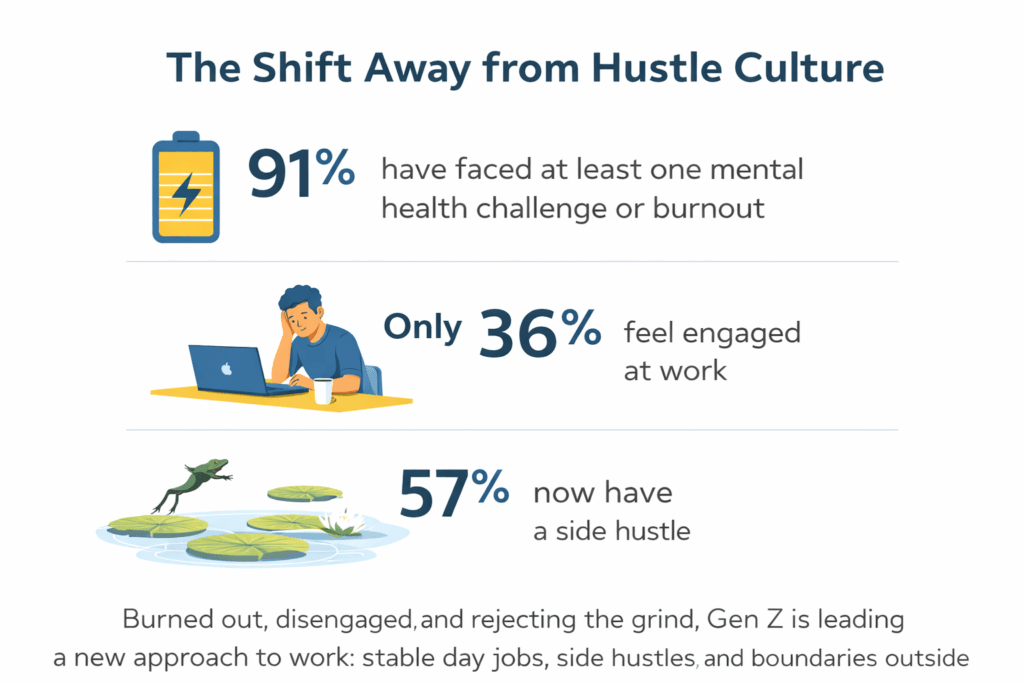
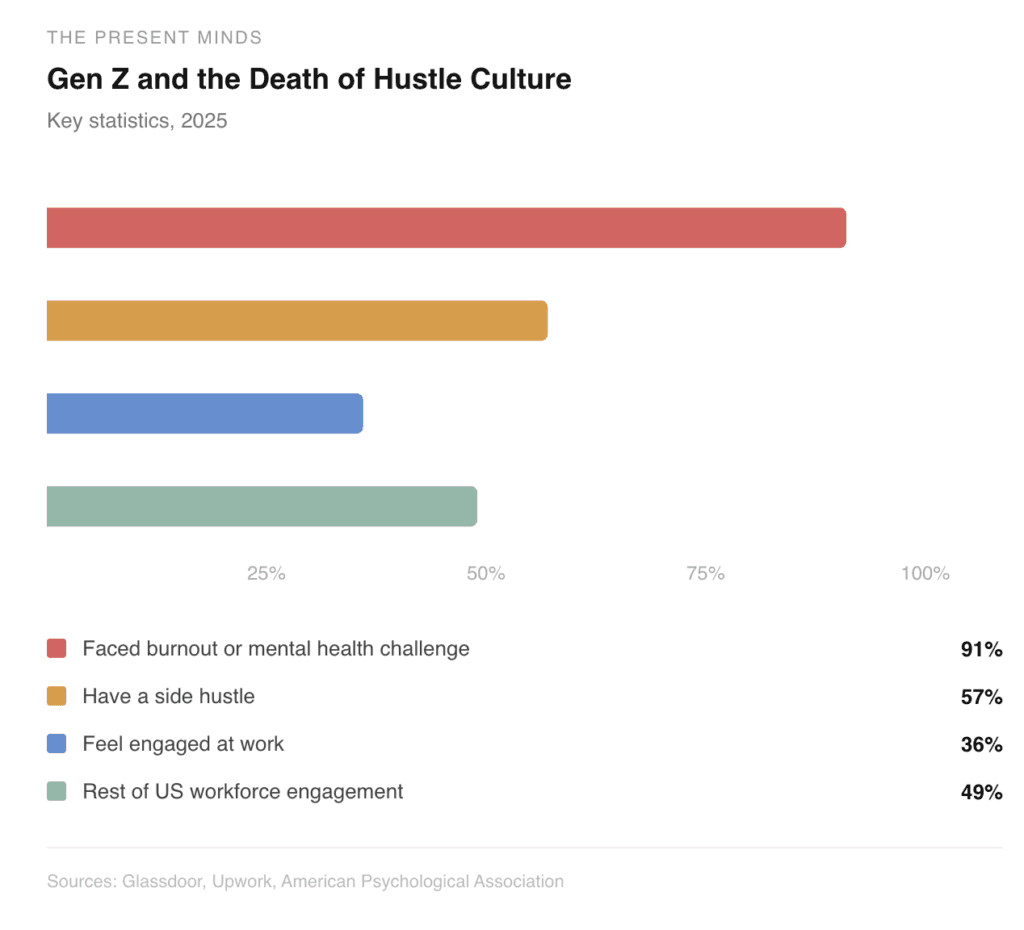
91 percent of Gen Z have faced at least one mental health challenge or burnout. That is not a fringe statistic. That is almost everyone.
Only 36 percent of Gen Z feel genuinely engaged at work, 13 points behind the rest of the US workforce.
These are people who entered the workforce having watched the hustle culture playbook play out in real time. They saw millennials optimise themselves into exhaustion. They saw the pandemic strip away every external marker of professional identity overnight. They saw burnout described as a badge of honour right up until the moment it landed people in hospitals and therapy offices.
They decided, collectively and pretty quickly, that they wanted something else.
Career Minimalism and the Lily Pad
A Glassdoor report coined the term “career minimalism” to describe what Gen Z is actually doing: treating jobs as a means to financial stability while saving real passion and ambition for hours outside work.
The image that keeps coming up in research is the lily pad rather than the ladder.
The corporate ladder implied a single vertical trajectory. Each rung was a promotion. The goal was the top. You climbed or you failed.
The lily pad is different. You hop from one interesting surface to another, not always upward, sometimes sideways, sometimes in a direction that has no name yet. Each hop is purposeful but not permanent. The identity is not in the job. The identity is in the movement and the choices behind it.
57 percent of Gen Z currently have a side hustle, more than any other generation. For many, the day job finances the passion project. One Glassdoor community member put it plainly: the nine-to-five funds the five-to-nine.
This is not laziness. It is a deliberate restructuring of where meaning lives.

What Quiet Quitting Was Really About
The phrase quiet quitting became a cultural flashpoint in 2022. It was immediately misunderstood by almost everyone who used it.
Critics described it as a generation unwilling to go above and beyond. As entitlement. As the collapse of work ethic.
What it actually described was something far more specific: workers deciding to do the job they were hired and paid to do, rather than the additional unpaid labour that hustle culture had normalised as expectation.
Anti-hustle is a conscious choice to prioritize meaningful work. It is about working smarter, not less. Quiet quitting is different: doing only the bare minimum because of disengagement.
The conflation of the two was convenient for employers and commentators who preferred the laziness narrative. It was less convenient for the people actually living through a genuine renegotiation of what work owes workers and what workers owe work.
That renegotiation is still happening. The outcome is not yet settled.

What the Body Was Trying to Say
There is a physiological dimension to this that the productivity conversation consistently ignores.
Chronic overwork does not produce more output. Past a certain threshold, it produces less, with significantly more damage.
Research consistently shows that cognitive performance declines sharply after roughly 50 hours of work per week. Sleep deprivation, which hustle culture glamourised as dedication, impairs decision-making, creativity and emotional regulation in ways that compound over time. The 5am club produces diminishing returns long before its members admit it.
The body was sending signals the culture told people to override.
Burnout was the result. Not weakness. Not failure. The predictable physiological outcome of asking a human nervous system to operate indefinitely beyond its sustainable capacity.
By 2030, Gen Z will account for 30 percent of the global workforce. They grew up watching this play out. The lesson they drew was not that they needed to be tougher. It was that the framework was broken.
What Replaced the Hustle
The interesting question is not what killed hustle culture. The interesting question is what is replacing it.
The answer is still forming. But some shapes are visible.
Work-life integration rather than balance. Not the old idea of keeping work and life in separate boxes, but weaving them together in a way that neither consumes the other. Flexibility as a non-negotiable rather than a perk. The ability to design the conditions under which you work as a baseline expectation rather than a reward for loyalty.
Identity outside the job title. This is the deepest shift and the one most connected to the identity cluster this article belongs to.When work is no longer the primary answer to the question of who you are, other answers have to be found. Community. Creative practice. Physical experience. Relationships. The things hustle culture deprioritised as distractions.
Gen Z’s formula is simple: stable jobs for security, side hustles for passion, strict boundaries for sustainability.
That is not a formula for underachievement. It is a formula for a sustainable life. The fact that it looks radical compared to the previous decade says more about how extreme the previous decade was than about how extreme this one is.

The Hustle Culture That Will Not Die
It is worth being honest about the limits of this shift.
Hustle culture is not equally dead everywhere. In certain industries, certain geographies, certain company cultures, the grind is still the norm and the expectation. The workers most able to reject it are the ones with the most market power, the most in-demand skills, the most financial cushion.
For the millions of people working multiple jobs not out of passion but out of economic necessity, the anti-hustle conversation can feel like a luxury discourse. Career minimalism is easier when you are not one missed paycheck from crisis.
The shift is real. It is also uneven. And the structural conditions that made hustle culture feel necessary, stagnant wages, housing costs, job insecurity, have not changed enough to make the new framework available to everyone.
That tension is not a reason to dismiss what is happening. It is a reason to take it seriously enough to ask what would need to change for more people to have the option.

The Identity Question Underneath It All
At its deepest, the death of hustle culture is an identity story.
For a decade, the job was the self. The title was the answer to who you are. The output was the measure of worth.
That framework is cracking because it was always fragile. Because identity built entirely on professional achievement has no floor when the achievement is interrupted, which it always eventually is. By redundancy, illness, burnout, or the simple fact that careers end and people do not.
What is being built in its place is slower, less legible, and harder to post on LinkedIn.
But it is more honest.
The hustle was never really about productivity. It was about belonging, status and the terror of stillness. The generation walking away from it is not less ambitious. It is asking a harder question about what ambition is actually for.
That question does not have a clean answer yet.
But it is the right question.
Read next: Who Are You When Everything Changes? The Psychology of Identity in Uncertain Times
What is dharma? what the mahabharata knew about losing everything
Deep questions to ask someone to know them better (that actually work)


 Psychology · Sep 22, 2026Chimpanzees Have Accents. They Grow into Them.
 The Margin · Sep 17, 2026People Are Seeing Ads in Their Dreams.
 Slow Meridian · Sep 16, 2026Autumn Leaves