
What marketing actually is tends to get lost very early in the conversation.
The textbooks arrive first. Segmentation. Targeting. Positioning. Brand equity. Consumer behaviour models arranged into frameworks with arrows pointing in tidy directions.
And somewhere between the first framework and the fifth, the person trying to understand marketing loses the thread of the thing itself, the living, human, surprisingly philosophical discipline underneath all the diagrams.
Marketing is not a technical subject that occasionally touches on human behaviour. It is a human subject that occasionally uses technical tools. That distinction changes everything about how it should be learned and what it should feel like to understand it.
The Promise Underneath Every Brand
Philip Kotler, whose name appears in the opening chapter of almost every marketing textbook ever written, described marketing as the science and art of exploring, creating, and delivering value.
Two words matter in that sentence. Science. Art. Not one or the other. Both, always, in tension with each other, neither sufficient without the other.
The science is the part that gets taught. The art is the part that gets demonstrated.
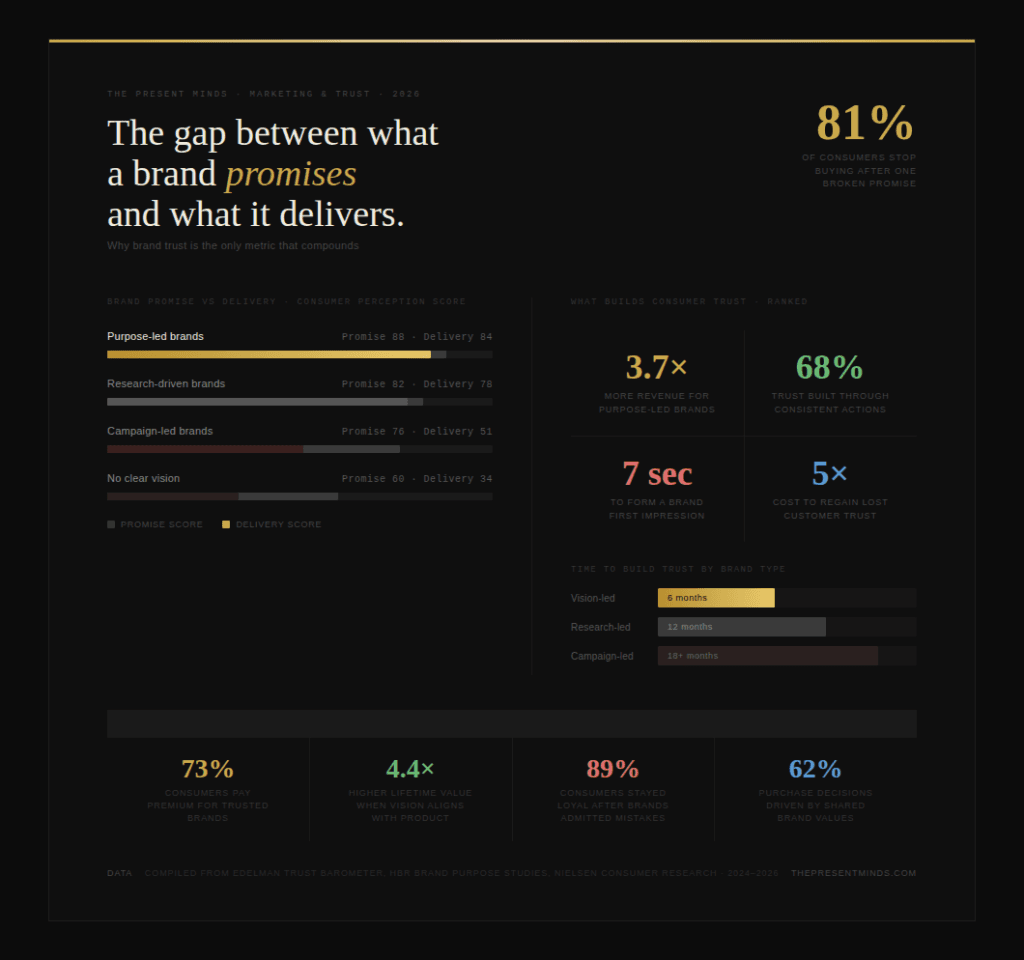
Marketing strategist David Aaker spent much of his career arguing that a brand is a promise to a customer. It sounds simple. The implications are not. A promise is not a logo. It is not a tagline or a colour palette or a campaign.
A promise is what you commit to delivering every single time, without exception, in every interaction, whether anyone is watching or not.
Most brands that fail do not fail because their product is poor or their advertising is weak. They fail because the promise and the reality came apart. Because what the brand said it was and what the customer actually experienced turned out to be different things.
The market has an extraordinarily precise memory for the gap between what a company claims and what it delivers.
Understanding this is not a marketing lesson. It is a lesson about integrity, applied to commerce.
Why You Do It Matters More Than What You Do
Simon Sinek built an entire framework, books, a TED talk watched by fifty million people, a consulting practice, around a single observation: people do not buy what you do, they buy why you do it.
The cynical reading of that statement is that companies need to manufacture a purpose narrative and attach it to their products to increase sales.
Some companies have taken exactly that approach and it shows what marketing actually is, immediately and embarrassingly, in the way their purpose statements read like they were written by a committee trying to sound sincere.
The non-cynical reading is more interesting. It says that vision is not a communication strategy. It is a compass.
A company that genuinely knows what it believes about the future, what problem it exists to solve, what kind of world it is trying to build, makes better decisions across every department, not just marketing, because every decision can be tested against the same question: does this align with why we exist?
When it does, the communication that follows does not need to work very hard. The product demonstrates the belief. The service demonstrates the belief. The way the company treats its own people demonstrates the belief. Marketing in this model is not persuasion. It is documentation.

What Research Actually Does
There is a version of market research that is purely mechanical. Surveys administered. Data collected. Segments identified. Target audience defined. This is useful. It is also not the interesting part.
Peter Drucker observed that the aim of marketing is to know and understand the customer so well that the product or service fits them and sells itself. The last three words are the ones worth sitting with. Sells itself. Not because it has been marketed brilliantly but because it is so precisely the thing someone needed that the explanation is almost unnecessary.
That level of fit does not come from a survey. It comes from a quality of attention to how people actually live, what they actually want, where the gap is between what exists and what they would choose if it existed.
Research, at its most useful, is a discipline of listening rather than a discipline of measuring. The tools, SWOT analysis, PESTLE, consumer behaviour studies, Porter’s five forces, are instruments for organising what the listening has produced. They are not substitutes for the listening itself.
Brands that skip the listening and go straight to the instruments end up with data that tells them how many people want a thing without telling them why, and without the why, the how tends to miss which further shows us that not everyone understands what marketing actually is.

The Gap Between the Idea and the Shelf
Once a company knows what it believes, what it is promising, and what its research has revealed about the people it wants to serve, the work becomes translation.
Segmentation identifies that not everyone wants the same thing. Targeting accepts that a company cannot serve everyone and makes a deliberate choice about who it is for. Positioning answers the question of how this brand wants to be understood relative to everything else available to the same person.
These three concepts together form the foundation of almost every strategic marketing decision that follows. They are not abstract. They are the answer to a series of very practical questions:
Who is this for? What do they need that they are not currently getting? Why should they believe we are the ones to give it to them?
When those answers are clear, the work of communication becomes considerably easier. When they are not, no amount of creative advertising rescues the confusion and explain to any creative team as to how and what marketing actually is.

What All of This Adds up To
The reason marketing is worth understanding, even for people who have no intention of working in marketing, is that it is a lens for reading the world that most people are already inside without knowing it.
Every brand you interact with has made a series of decisions about what to promise, who to serve, and how to demonstrate its values. Every advertisement is a strategic statement about identity.
Every product launch is the visible end of a long chain of research, positioning, and belief.
Learning to see those decisions is not the same as becoming sceptical of them. It is becoming literate in the language the commercial world uses to communicate value. It is understanding that the brands you trust did not earn your trust by accident.
They earned it through consistent alignment between what they said they were and what they actually were, repeated often enough that the gap between promise and experience closed.
Marketing is, in the end, a study in trust. How it is built. How it is broken. How long it takes to repair. How quickly it can be destroyed by a single decision that reveals the promise was never genuine.
That is not a technical subject. It is a human one.
Read next: What We Inherit From Our Parents: It Is More Than You Think · Why South Asian Parents Don’t Say I Love You



 Psychology · Sep 22, 2026Chimpanzees Have Accents. They Grow into Them.
 The Margin · Sep 17, 2026People Are Seeing Ads in Their Dreams.
 Slow Meridian · Sep 16, 2026Autumn Leaves