
A Horse and Two Goats by RK Narayan is the only story on this list that will make you laugh.
It will also, if you sit with it long enough, make you feel something considerably more complicated than laughter.
This is what Narayan does. He finds the comedy in the gap between people and then, just when you are enjoying the comedy, he shows you how wide the gap actually is.
The Smallest Village in India
Kritam is one of the smallest villages in India. Thirty houses. Most of them thatched huts. One shop. One Big House made of brick and cement, which is where the well-off family lives and where everyone else gets their water.
The village’s name means crown in Tamil. Narayan notes this without comment. He does not need to add anything.
Muni lives in one of the huts with his wife. He is old. He is poor. He was not always this poor. Once he had forty sheep and goats. A butcher from town would visit and buy animals, and they would sit together chewing betel leaves and drinking bhang, and life had a certain loose, comfortable texture.
Then pestilence came. Or a neighbour’s curse, depending on who you asked. Either way, forty animals became two. Two scraggly, bony goats that have outlived their usefulness and that Muni takes to graze by the highway every day out of habit and because there is nothing else to do.
On this particular morning, there is no food in the house. Muni wants drumstick curry. His wife tells him to bring rice, millet, chilli, coriander, mustard, curry leaves, gingelley oil, and one large potato. He goes to the village shop and tries to buy on credit.
The shopkeeper does not look up from his newspaper.
Muni walks back to his wife, collects his two goats, and sets off for the highway. He will fast until evening and hope she earns something somewhere.
He has been reduced to a man whose optimism is a hope that his wife earns something somewhere.
The Statue
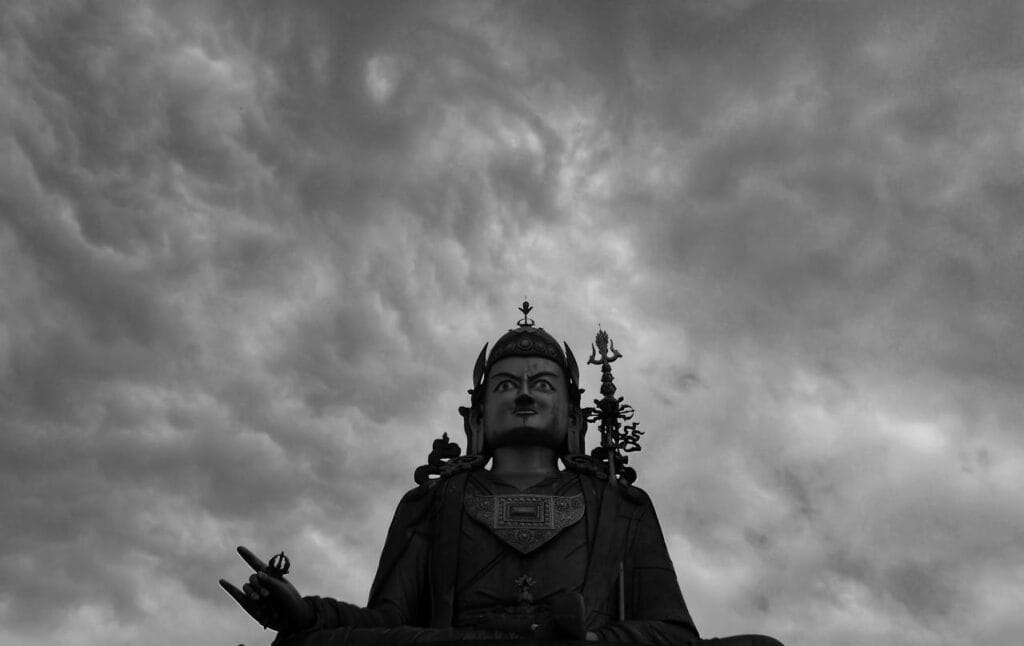
At the edge of the highway stands a clay horse. Large, ancient, magnificent in the way that only things made with great care for purposes larger than decoration can be magnificent.
Muni’s grandfather told him about it. His grandfather’s grandfather told him. The horse is Kalki. The final avatar of Vishnu. At the end of the Kali Yuga, the darkest age of man, Kalki will descend on a white horse and trample all evil-doers and reset the cycle of the world. The statue has stood here since before anyone can remember, watching the highway with ancient, patient eyes.
Muni sits on its pedestal every day. He watches the trucks go by. He feeds this information to his wife each evening, carefully, as if it is nourishment.
Today a yellow station wagon comes barrelling down the highway and stops in front of him.
The Red-Faced Man
A foreigner gets out of the car.
He is large. He is red-faced. He is wearing khaki. Muni’s first thought is: policeman. Or soldier. Either way, a man with authority and a warrant, here about the murder that happened in a nearby village some weeks ago.
He gets up to run.
He is seventy years old with two goats. He does not get very far.
The foreigner asks about a gas station. In English. Muni understands none of it. The foreigner repeats himself in louder English, which is the universal strategy of people who have never had to learn another language.
Still nothing.
Then the foreigner takes out a silver cigarette case and offers Muni a smoke.
Muni draws a deep puff. He coughs. Then he coughs some more. The coughing is, Narayan writes, racking but extremely pleasant.
A man who gives you a cigarette is probably not here about the murder.
Muni relaxes slightly. He begins to talk.
The Conversation
Here is the conversation, roughly speaking.
Muni explains that he is innocent of all crimes. He speaks of his family history. He describes his childhood as a minor actor in mythological stage productions. He tells the story of Kalki in considerable and loving detail: the white horse, the final avatar, the end of the Kali Yuga, the trampling of evil-doers.
The American, not understanding a single word, listens politely. He smiles. He nods. He is, Narayan suggests, a fundamentally affable man. He also, at some point, becomes absolutely transfixed by the horse statue.
He wants it. He wants it immediately and completely, the way Americans in Narayan’s story want things. He decides it would look extraordinary in the middle of his living room. His wife Ruth will probably disapprove. He throws away his return plane ticket in his mind and starts planning to ship the statue back to New York on a freighter.
He tries to communicate this to Muni.
Muni, listening carefully, concludes that the man wants to buy his goats.
Two people, talking at full volume, in perfect good faith, about completely different things.
The American gestures at the statue. Muni gestures at the goats. The American produces a hundred-rupee note. Muni has never held a hundred rupees in one hand in recent memory. He thinks of the drumstick curry. He thinks of the shop that would not give him credit this morning.
He takes the money.
The American believes he has bought a horse.
Muni believes he has sold two goats.
Both of them are satisfied.
The Journey Home
Muni walks home quickly. He has not moved this fast in years.
He places the hundred-rupee note in front of his wife. She stares at it. She asks where it came from. He explains that a foreign man stopped and bought his goats.
She looks at the note. She looks at her husband. She tells him he must have stolen it and she will go to her parents’ house before the police arrive.
Then they hear something at the door.
Bleating.
Both goats have followed him home. They always follow their owner. This is what goats do. This is what goats have always done.
Muni stares at the goats. The goats stare at Muni. His wife stares at both of them and her suspicion crystallises into something close to certainty.
Meanwhile, back at the highway, the American is waiting for Muni to return with help to move the statue. When Muni does not come back, he flags down a passing truck and pays the drivers to help him manoeuvre the ancient clay horse off its pedestal and into his station wagon. He siphons petrol from their tank to restart his engine.
He drives away with a horse that has stood at the edge of Kritam since before anyone can remember, strapped imperfectly into the back of a yellow station wagon bound for a living room in New York.
Neither man will ever fully understand what happened.
Both of them got exactly what they wanted. Neither of them got what they paid for.
What Narayan Was Actually Doing
This is not, despite everything, a simple comedy of errors.
Narayan was writing in 1965, nearly two decades after Indian independence. He was watching a specific kind of encounter play out between India and the West. The American arrives in a country he cannot speak, assumes his own language is sufficient, and buys a sacred object to use as a conversation piece in his living room. He is not malicious. He is genuinely affable. He gives Muni a cigarette and listens patiently to a monologue he cannot understand and pays what seems to him a reasonable price.
He just cannot conceive that the object he is buying might be something other than an interesting decoration.
Muni knows everything about the horse. The mythology. The prophecy. The generations of his family who grew up beside it. He explains it at length, in careful Tamil, with genuine feeling. None of it reaches the American. Not because the American is stupid. Because the language between them is missing, and the language carries the meaning.
The statue leaves Kritam in the back of a station wagon. The guardian of the village, the avatar of Vishnu, the object of Muni’s grandfather’s stories, becomes a living room centrepiece in New York. The village gets a hundred rupees and two confused goats.
Everything was transacted in perfect politeness. Nothing was understood. This is the story of most encounters between worlds.

The Part That Stays
The comedy stays. Narayan is too good a writer for it not to.
The image of Muni coughing magnificently on a foreign cigarette while discussing his complete innocence in Tamil to a man asking for a gas station in English is one of the funniest images in Indian literature.
But what stays alongside the comedy is the statue. The empty pedestal at the edge of the highway, where Muni’s grandfather taught him about Kalki, where Muni has sat every day for decades watching the trucks go by, where the world’s end will begin when the time comes.
The pedestal is empty now. Kalki is in New York.
The world’s end, Narayan seems to be saying, will have to make other arrangements.
Buy the Book Here: Buy on AMAZON
Read next: Tagore’s The Postmaster: a story about being left behind . Why costa rica has no army and what 77 years without one actually looks like
 Psychology · Sep 22, 2026Chimpanzees Have Accents. They Grow into Them.
 The Margin · Sep 17, 2026People Are Seeing Ads in Their Dreams.
 Slow Meridian · Sep 16, 2026Autumn Leaves