Some links on this page may be affiliate links. If you purchase through them, we may earn a commission at no extra cost to you.
Written by
The Present Minds
Administrator
A digital sanctuary for the overstimulated.
Clarity. Depth. Silence.
KEY TAKEAWAYS
Baby macaque videos exploit human empathy by humanizing animals to create emotional attachment before showing cruelty, revealing a disturbing psychological manipulation.
Algorithms on social media platforms amplify violent content by rewarding engagement, progressively normalizing cruelty and escalating viewer commitment.
Viewers of such content are not necessarily sadists; ordinary human psychology, including schadenfreude and social comparison, plays a key role in their consumption.
Online anonymity exposes pre-existing dark traits rather than creating them, with social media providing communities and markets for harmful behaviors.
The failure of platforms to remove animal cruelty content reflects economic incentives prioritizing revenue over ethical moderation until external pressure forces action.
GLOSSARY
Schadenfreude
A psychological phenomenon where people take pleasure in the misfortune of others, comprising aggression-based, rivalry-based, and justice-based forms.
Dehumanization
The process by which victims are perceived as less than fully human, reducing empathy and enabling cruelty; in this context, reversed by first humanizing animals to manipulate viewers.
Escalation of Commitment
A behavioral psychology principle where increased investment, including emotional, makes it harder to disengage, contributing to repeated viewing of harmful content.
Dark Triad Traits
A set of personality traits including narcissism, Machiavellianism, and psychopathy, linked to higher levels of schadenfreude and antisocial behavior, pre-existing before internet use.
Algorithmic Amplification
The process by which social media algorithms promote content that generates engagement, regardless of ethical considerations, leading to increased visibility of violent videos.
Online Animal Abuse Networks
Organized groups on platforms like Telegram that commission and distribute videos of animal cruelty, often involving payment for specific acts.
FAQ
Why are baby macaques specifically targeted in these cruelty videos?
Baby macaques are targeted because their behaviors and appearances closely resemble human infants, such as crying and clinging, which creates emotional attachment in viewers. This humanization is used deliberately to manipulate empathy and make the cruelty more impactful.
Are the viewers of these videos necessarily sadistic individuals?
No, most viewers are not sadists by clinical or criminal definitions. Instead, ordinary human psychological traits like curiosity, schadenfreude, and social comparison drive engagement. The content exploits these traits, leading many to watch despite discomfort.
How do social media algorithms contribute to the spread of these videos?
Algorithms prioritize content that generates engagement, such as repeated views and comments, without distinguishing between positive or negative reactions. This leads to amplification of violent content as viewers are shown progressively more intense videos, normalizing cruelty.
What role does online anonymity play in the consumption and creation of this content?
Online anonymity does not create harmful tendencies but reveals pre-existing dark traits like narcissism and psychopathy. The internet provides a community and distribution channel for individuals with these traits to engage in and share abusive content.
Why have social media platforms been slow to remove these animal cruelty videos?
Platforms have economic incentives to keep high-engagement content online because it generates revenue. Despite acknowledging the content's inappropriateness, they often delay removal until external pressure from journalists and prosecutors forces action.
EDITORIAL NOTE
This piece is part of The Present Minds — essays on psychology, identity, and modern life.
Posted by The Present Minds • February 27, 2026 • Editorial
Baby monkey videos psychology: why we watch
This article contains descriptions of animal cruelty. Nothing graphic is detailed, but the subject matter is disturbing. It is written not to sensationalise but to understand a phenomenon that psychology and criminology researchers say we urgently need to talk about.
The psychology behind baby monkey videos reveals something uncomfortable about how human beings behave online.
There is a specific kind of video that has been circulating on YouTube, Facebook, TikTok and Telegram for years.
A baby macaque monkey, usually just weeks old, usually wearing a small shirt or diaper to make it look like a human infant, is filmed being tormented. Sometimes slowly. Sometimes to music. The titles use broken English phrases like “million tears” or “million sadness.” The comments underneath fill with hundreds of thousands of responses from people who watched until the end.
Between September 2021 and May 2023, a coalition of animal protection organisations tracked these videos across social media. By the time they published their findings, the content had accumulated over twelve billion views. Not twelve million. Twelve billion. That number is not a typo, and it is not explained by accidental clicks.
Something is drawing people back.
The question this article is really asking is not about the monkeys, though their suffering is real and the people responsible for it are now facing criminal prosecution in multiple countries. The question is about the viewers. About us. About what it says when this content, repeated and searchable and endlessly available, becomes one of the most watched categories of video on platforms that claim to prohibit it.
The reality behind online animal abuse networks
The supply side of this phenomenon was exposed in detail by a BBC World Service investigation in 2023. Undercover journalists entered private Telegram groups where hundreds of people gathered to commission specific torture acts, paying Indonesians and others in Southeast Asia to carry them out on camera. Users could pay to “adopt” a baby macaque, receiving five video requests in the adoption fee, with additional requests available for twenty dollars each.
The people commissioning these videos were not fringe anonymous accounts. Among those arrested were an American man known online as “Torture King,” and two British women. Two Indonesian men received prison sentences for carrying out the abuse. A former US Air Force officer was indicted. A former schoolteacher was convicted. An American man named Ronald Bedra was imprisoned for his role leading a group called “Million Tears.”
Between September 2021 and March 2023, the coalition recorded 1,226 content links from Facebook, Instagram, TikTok and YouTube. Sixty percent showed macaques being directly physically abused. Twelve percent showed monkeys being beaten, burnt alive, or tortured until death. All of the content collectively had been viewed over twelve billion times.
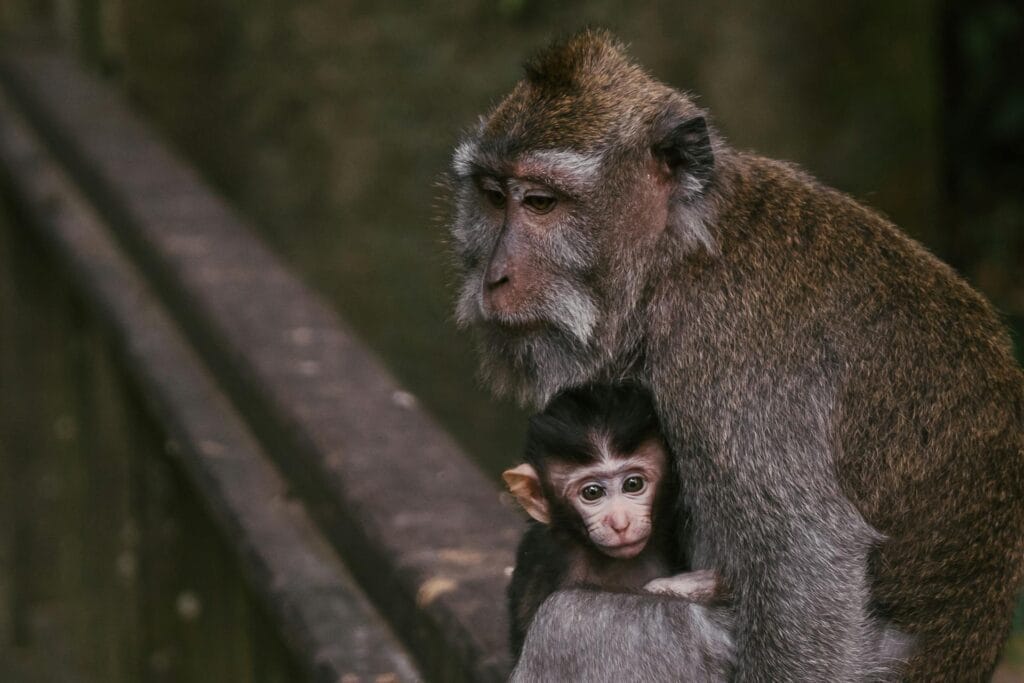
Baby macaques are specifically targeted, researchers found, because of their perceived close similarities to human babies. They cry. They reach out. They cling to things. They have faces that register distress in ways that are recognisably, uncomfortably familiar.
That familiarity is not incidental. It is the mechanism.
The psychology of watching cruelty
Here is where the psychology becomes important, and also where it becomes genuinely uncomfortable.
The baby monkey videos psychology researchers are studying does not begin with sadism. It begins with ordinary human curiosity and the mechanics of digital platforms.
Not everyone watching these videos is a sadist. The audience is not a single type of person and collapsing it into one category misses something important about how ordinary human psychology leads people into dark places online.
Researchers at Emory University who spent three decades studying schadenfreude, the pleasure humans take in the misfortune of others, found that the emotion comprises three separable but interrelated forms: aggression-based, rivalry-based, and justice-based. What pulls people away from it is the ability to feel empathy and to perceive others as fully human.
The critical word there is “human.”
Baby macaques are dressed in human infant clothing. Given names. Filmed in domestic settings. Given backstories in video captions. They are presented, deliberately, as almost-human. And then harmed. The viewer is asked to hold both of those things at once: the familiarity that creates emotional investment, and the animal status that provides just enough distance to watch without feeling the full weight of what is happening.
This is not an accident of content creation. It is the design.
Psychologists have found that schadenfreude can cause people to dehumanize others, making the subject of pain seem less than fully human. In this case, the process runs in reverse: the monkeys are first humanised to create attachment, then the attachment is used as fuel for something darker. The viewer’s empathy is activated and then twisted.
How algorithms amplify violent content
There is a principle in behavioural psychology called the escalation of commitment, sometimes called the sunk cost effect. The more you invest in something, even emotionally, the harder it becomes to stop. You clicked once. The algorithm showed you more. You watched a few seconds. You came back. Each small step felt manageable.
Research from the University of British Columbia found that everyday sadists, people who are not criminal and not diagnosed with any disorder, possess an intrinsic motivation to observe others’ suffering, and are willing to expend extra effort to do so. This is not describing serial killers. It is describing a recognisable, measurable trait distributed across the general population at low levels.
Most people who end up watching this content are not, by any conventional definition, sadistic. What they are is human in a specific and inconvenient way. Human beings are ultrasocial animals, constantly aware of hierarchy and status. One way for social status to improve is for someone else to lower theirs. When we see someone or something experience misfortune, the brain can register a small, automatic burst of satisfaction.
That burst is usually harmless in ordinary life. Someone slips on ice in a viral clip. A celebrity makes a fool of themselves at an awards ceremony. The feeling is brief, often followed by mild guilt, and we move on.
But the algorithm does not move on.
The algorithm reads the engagement data, which does not distinguish between the satisfaction of outrage and the satisfaction of pleasure. It sees that you watched to the end. It sees that you returned. It optimises accordingly. Social media platforms amplify social comparison and encourage rapid, repeated judgments, creating an environment where misfortune spreads instantly and the emotional response spreads with it.
The viewer who started with a reaction of shocked curiosity is, over time, shown progressively more intense versions of the same content. Each video normalises the last one. The threshold shifts.
This is the pipeline that criminologists and platform researchers have been documenting for years. It does not require the viewer to be a bad person at the start. It requires only that the platform’s incentives and the viewer’s ordinary psychological vulnerabilities align. And they do, reliably, every time.
What baby monkey videos reveal about human psychology
A veterinarian with decades of experience, Dr Nedim Buyukmihci, co-founder of Action for Primates, described the content as the worst sadism he had ever seen, and said it was “untenable that any social media company would tolerate the existence of such individuals and groups on their platforms.”
YouTube told researchers that abuse “had no place” on the platform. Facebook said the same. Both platforms continued hosting the content for years after being directly notified of specific videos by researchers and journalists. Animal advocacy groups reported that YouTube consistently failed to take down videos depicting animal cruelty even after direct reports, enabling animal cruelty communities to connect and escalate over months and years.
This is not a moderation failure in the sense of being overwhelmed. It is a moderation failure in the sense of being a choice. Content with twelve billion views generates revenue. Investigating and removing it costs money. The economic logic, absent external pressure, runs in one direction.
The platforms changed their posture only when journalists went undercover, prosecutors filed charges, and the story became too public to ignore. Not before.
Three things to watch for the psychology of watching cruelty
There are several things this phenomenon makes visible that we usually prefer not to examine.
The first is that empathy is not a fixed quantity. It is conditional, directed, and easily manipulated. Research from Princeton University found that people often fail to empathize with certain groups, and that feeling pleasure instead of empathy disrupts the link between observing suffering and being motivated to help. The researchers studying monkey torture specifically noted that the baby macaques’ humanisation was the hook, not an afterthought. Making something look vulnerable and familiar is the oldest trick in the manipulation of human attention.
The second is that online anonymity does not create darkness in people. It reveals darkness that was already present. A 2014 study found that people who scored higher on Dark Triad traits, which include narcissism, Machiavellianism and psychopathy, also had higher levels of schadenfreude, greater anti-social activities, and greater interest in sensationalism. Those traits existed before the internet. The internet gave them a community, a market, and a distribution channel.
The third is about community. One of the most disturbing aspects of the Telegram torture groups was not the violence itself but the social structure around it. People with usernames and inside jokes and hierarchies. Enthusiasm rewarded with status. Requests encouraged because engagement was the currency. This is the same social architecture as any fan community or online hobby group. The content is different. The human need being served, to belong, to be recognised, to participate in something shared, is identical.
That parallel is not an excuse. It is a diagnosis.
The necessary and uncomfortable conclusion
Most people reading this have never watched one of these videos and never will.
But most people reading this have, at some point, watched something online that made them feel vaguely uneasy afterward, stayed longer in a comment section than was good for them, or found themselves three clicks deep in content they would not have chosen consciously. The mechanisms are the same. The content is different. The distance between them is real, but it is not infinite.
Researchers at Emory University concluded that dehumanization appears to be at the core of schadenfreude, and that the scenarios which elicit it tend to promote dehumanization. The direction of travel in algorithmic content is always toward more intensity, more specificity, more engagement. The platforms are built to take ordinary human psychology and push it further than it would go on its own.
The baby monkey videos are an extreme manifestation of something running at low intensity across nearly all of social media, all of the time. The question of why people watch them is uncomfortable precisely because the answer involves mechanisms that are not exclusive to people who would ever consider watching them.
We are all wired for this. We are not all the same distance from it.
The difference, for most people, is circumstance and algorithm rather than character. That should concern us more than it does.
If you encounter monkey torture content online, do not engage with it. Report it directly to the platform and to SMACC (Social Media Animal Cruelty Coalition) at AsiaForAnimals.com. Engagement of any kind, including comments expressing disgust, increases the algorithmic visibility of the content.
Some links on this page may be affiliate links. If you purchase through them, we may earn a commission at no extra cost to you.
Written by
The Present Minds
Administrator
A digital sanctuary for the overstimulated.
Clarity. Depth. Silence.
KEY TAKEAWAYS
Baby macaque videos exploit human empathy by humanizing animals to create emotional attachment before showing cruelty, revealing a disturbing psychological manipulation.
Algorithms on social media platforms amplify violent content by rewarding engagement, progressively normalizing cruelty and escalating viewer commitment.
Viewers of such content are not necessarily sadists; ordinary human psychology, including schadenfreude and social comparison, plays a key role in their consumption.
Online anonymity exposes pre-existing dark traits rather than creating them, with social media providing communities and markets for harmful behaviors.
The failure of platforms to remove animal cruelty content reflects economic incentives prioritizing revenue over ethical moderation until external pressure forces action.
GLOSSARY
Schadenfreude
A psychological phenomenon where people take pleasure in the misfortune of others, comprising aggression-based, rivalry-based, and justice-based forms.
Dehumanization
The process by which victims are perceived as less than fully human, reducing empathy and enabling cruelty; in this context, reversed by first humanizing animals to manipulate viewers.
Escalation of Commitment
A behavioral psychology principle where increased investment, including emotional, makes it harder to disengage, contributing to repeated viewing of harmful content.
Dark Triad Traits
A set of personality traits including narcissism, Machiavellianism, and psychopathy, linked to higher levels of schadenfreude and antisocial behavior, pre-existing before internet use.
Algorithmic Amplification
The process by which social media algorithms promote content that generates engagement, regardless of ethical considerations, leading to increased visibility of violent videos.
Online Animal Abuse Networks
Organized groups on platforms like Telegram that commission and distribute videos of animal cruelty, often involving payment for specific acts.
FAQ
Why are baby macaques specifically targeted in these cruelty videos?
Baby macaques are targeted because their behaviors and appearances closely resemble human infants, such as crying and clinging, which creates emotional attachment in viewers. This humanization is used deliberately to manipulate empathy and make the cruelty more impactful.
Are the viewers of these videos necessarily sadistic individuals?
No, most viewers are not sadists by clinical or criminal definitions. Instead, ordinary human psychological traits like curiosity, schadenfreude, and social comparison drive engagement. The content exploits these traits, leading many to watch despite discomfort.
How do social media algorithms contribute to the spread of these videos?
Algorithms prioritize content that generates engagement, such as repeated views and comments, without distinguishing between positive or negative reactions. This leads to amplification of violent content as viewers are shown progressively more intense videos, normalizing cruelty.
What role does online anonymity play in the consumption and creation of this content?
Online anonymity does not create harmful tendencies but reveals pre-existing dark traits like narcissism and psychopathy. The internet provides a community and distribution channel for individuals with these traits to engage in and share abusive content.
Why have social media platforms been slow to remove these animal cruelty videos?
Platforms have economic incentives to keep high-engagement content online because it generates revenue. Despite acknowledging the content's inappropriateness, they often delay removal until external pressure from journalists and prosecutors forces action.
EDITORIAL NOTE
This piece is part of The Present Minds — essays on psychology, identity, and modern life.








Leave a Reply