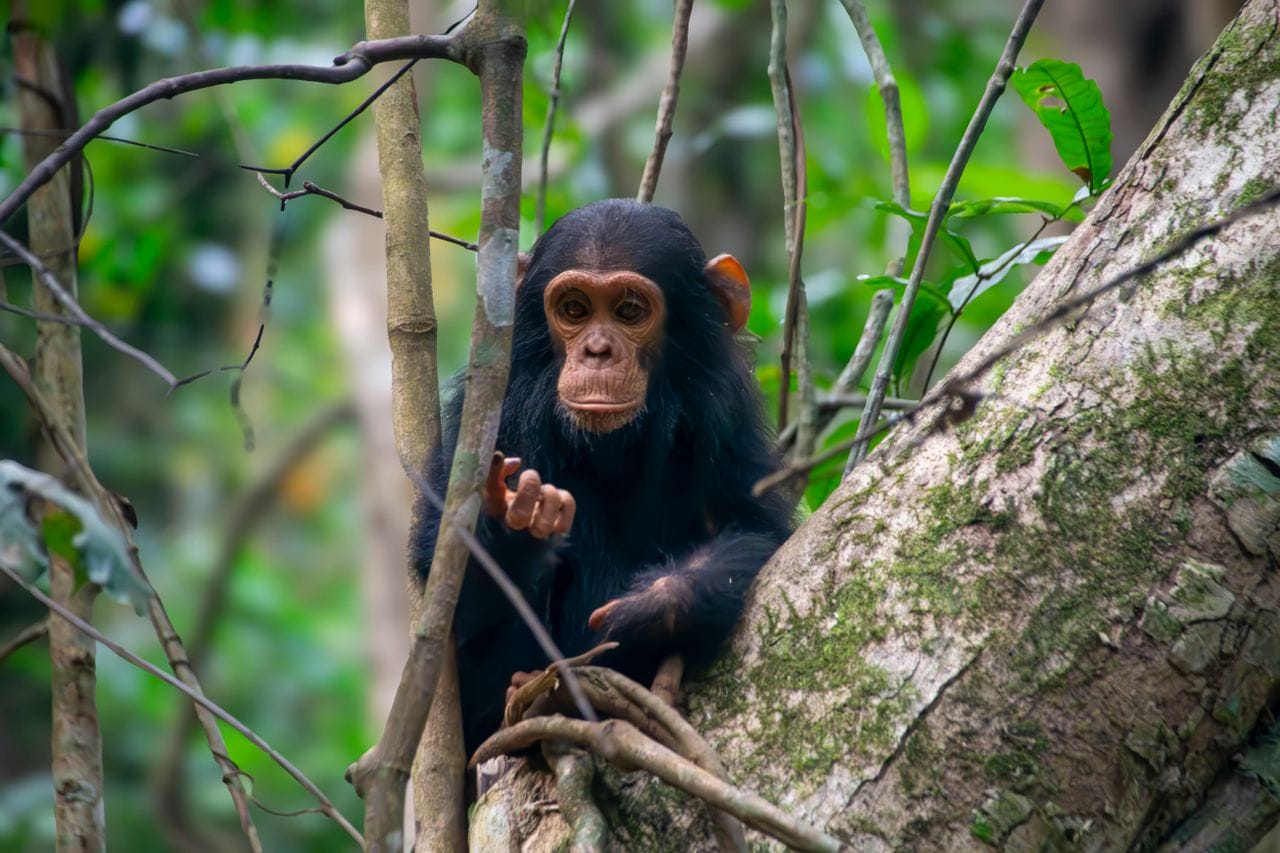
Do chimpanzees have accents? Until recently, I would have put that question in the same category as whether dogs have favourite songs. Interesting to think about, but probably difficult to prove.
Then researchers listened to more than 11,000 sounds made by young chimpanzees living in two different parts of Africa.
They listened to them laugh.
They listened to them grunt.
They listened to them whimper.
And when they compared the sounds, they found something strange. The chimpanzees from one place sounded different from the chimpanzees in the other.
Even more interestingly, those differences became clearer as the chimps grew older.
That is why researchers are comfortable using a surprisingly human word for what they found.
Dialects.
Or, in much simpler language, something rather close to accents.
Do Chimpanzees Have Accents? 3 Surprising Findings
The study looked at young chimpanzees from two populations.
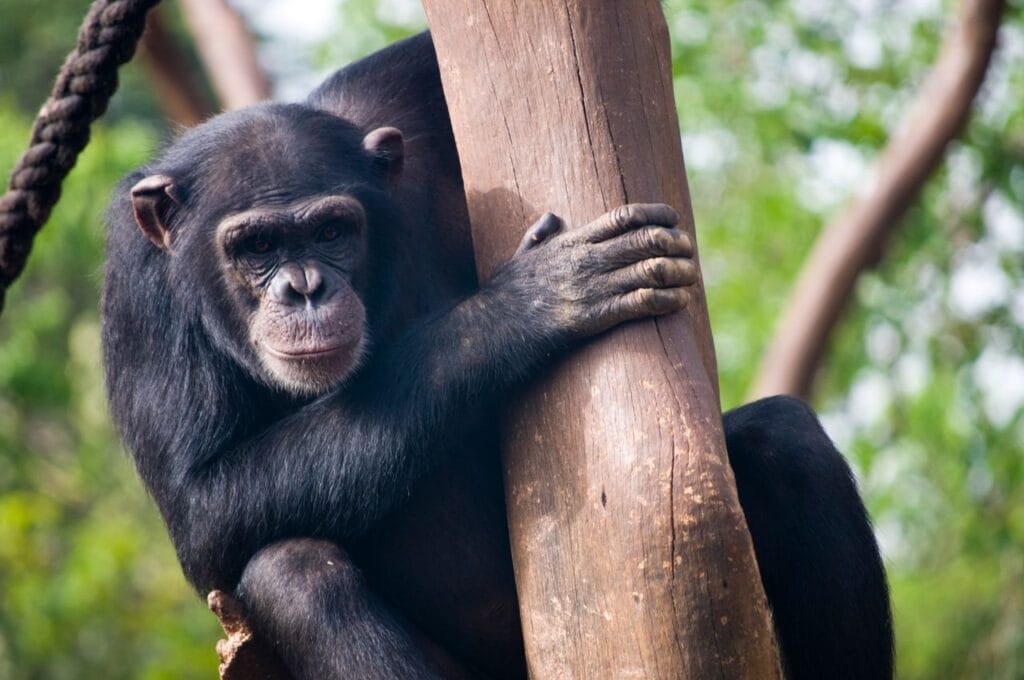
One group lived at Gombe National Park in Tanzania, the place made famous by decades of chimpanzee research. These animals live wild in tropical forest.
The other group lived at Chimfunshi Wildlife Orphanage in Zambia, where chimpanzees live in large, semi-wild areas surrounded by a more open type of woodland.
The researchers studied 30 chimpanzees in total, from infants up to juveniles around ten years old. Between them, the animals produced 11,225 usable sounds: thousands of laughs, grunts and whimpers.
They then looked at small details in those sounds.
How long they lasted.
Their frequency.
Their timing.
The way different parts of a call changed.
It was enough to reveal where a chimp was from surprisingly often.
The laughs sounded different.
The grunts sounded different.
And among the older chimpanzees, even the whimpers carried a clear local pattern.
To us, both animals might simply sound like chimpanzees.
The computer analysis could hear something more specific.
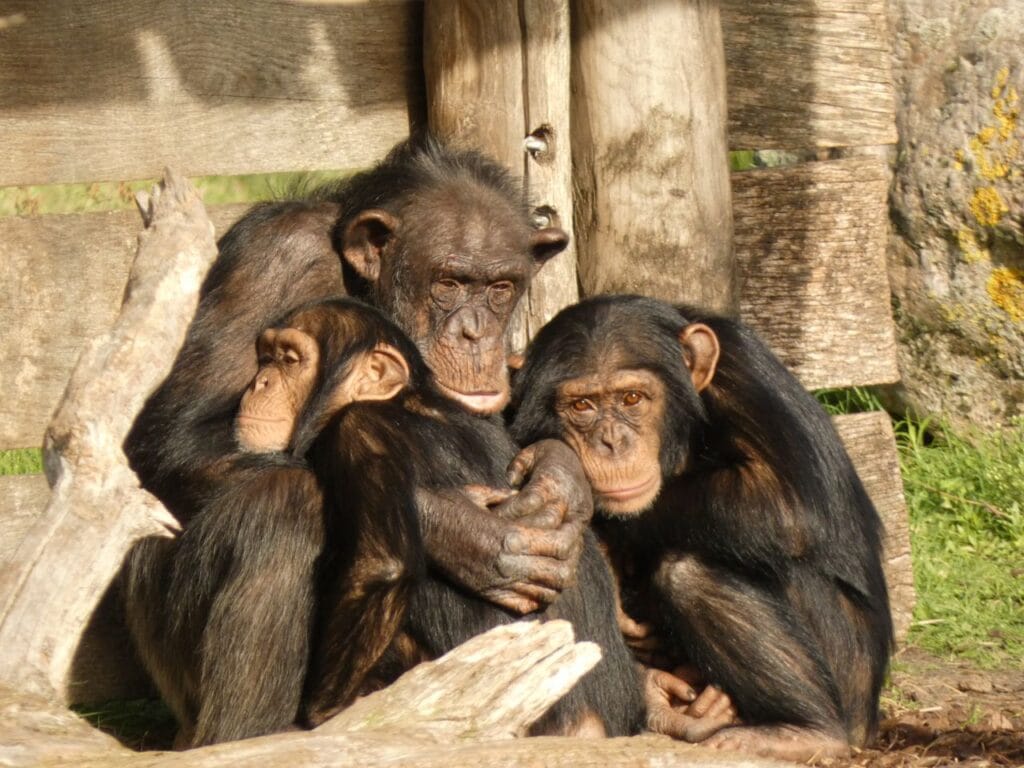
The Younger Chimps Were More Similar
The question do chimpanzees have accents sounds almost silly until you realise that the researchers could often tell which population an animal came from just by analysing its calls.
This is where the study gets much more interesting.
If chimpanzees from two places simply sounded different throughout their lives, there would be several obvious explanations.
Perhaps the groups are genetically different.
Perhaps their bodies develop differently.
Perhaps their surroundings change the way sound travels.
But the researchers compared younger and older animals.
The population differences were weaker among infants.
Among juveniles, they became much stronger.
Grunts and laughter already contained some clues about where an infant came from. Whimpers did not show a clear difference between the two groups at that early age.
Later, that changed.
By the juvenile years, all three types of calls carried stronger signs of which population the chimp belonged to.
In other words, the chimps seemed to sound more like their local group as they grew up.
That sounds very familiar.
This Is a Little Like What Happens to US
Human babies do not arrive speaking with a London accent, a Bangkok accent or a New York accent.
They acquire those patterns while growing up around other people.
Someone raised in Glasgow ends up sounding different from someone raised in Toronto, even though both are perfectly capable of making the same basic human sounds.
And accents are not limited to words.
Research has found that even human laughter can vary across cultures. The sounds we make are shaped partly by biology, but also by the people and places around us.
Chimpanzees obviously do not speak English with regional pronunciation.
They do not have human language, with vocabulary and grammar, and the researchers are very clear about that.
Calling these differences “accents” is a useful comparison, not a claim that two chimps from Zambia are discussing bananas in different dialects.
What the study shows is simpler.
Where a chimpanzee grows up seems to leave a mark on how it sounds.
But Are They Actually Learning the Accent?
This is the question the study cannot completely answer.
The fact that the differences became stronger with age suggests that genes alone are probably not the whole explanation.
But that does not automatically mean young chimpanzees are deliberately copying their neighbours.
There are other possibilities.
The two populations live in very different environments. Gombe contains dense tropical forest. Chimfunshi has more open woodland.
That matters because sound has to travel through those places.
A call that works well in dense forest may not work exactly the same way in a more open environment. Over time, animals living in different habitats could develop slightly different ways of producing sounds.
Their social lives may matter too.
Young chimpanzees spend increasing amounts of time interacting with other chimps as they grow. Laughter, for example, happens often during play.
If you repeatedly hear and interact with the same group, your own sounds could gradually become more like theirs.
There is already evidence from previous chimpanzee research that groups brought together can begin making some calls more similarly over time.
Then there is simple physical development. A chimp’s throat, breathing and control over its voice change while it grows.
So the researchers are not saying they have found one neat explanation.
They are saying something more careful.
Chimpanzee voices appear to be shaped by a mixture of biology, development, social life and the environment around them.

One Sound Was Particularly Interesting
The whimpers stood out.
Among the youngest chimpanzees, the researchers could not reliably tell the two populations apart from their whimpers.
Later, they could.
The researchers think there may be a reason distress sounds behave differently.
If a baby chimp is frightened or needs its mother, a whimper has a very basic job. It needs to be understood.
Changing that sound too much could be a bad idea.
So distress calls may be more fixed when chimpanzees are young, while sounds such as laughter and grunting have more room to vary.
Humans show something that may be loosely similar.
Laughter varies considerably between cultures, while screams and cries tend to have more features in common.
Some sounds may simply need to remain understandable to everyone.
Others have more freedom to become local.
Why Scientists Care About Chimpanzee Accents
This study is not really about giving chimpanzees cute regional accents.
It is about a much larger question.
Where did our ability to change the way we sound come from?
Human speech is extraordinarily flexible. We can learn new languages, imitate accents, change pronunciation and adapt the way we speak depending on who we are around.
For a long time, calls made by other primates were often seen as much more fixed. An animal was assumed to be born with a set of calls and then simply use them.
That picture has been getting harder to defend.
Chimpanzees have already shown signs that their calls can change with social experience. Other primates have shown similar flexibility.
Now this study suggests that those local differences can develop gradually while chimpanzees are still young.
That does not mean chimpanzees are halfway to having conversations.
It means some of the flexibility needed for human speech may have much older roots than speech itself.
There Is One Big Reason Not to Get Carried Away
Thirty chimpanzees is not every chimpanzee.
And the study compared only two populations.
The researchers also could not separate every possible cause.
The groups differ socially, geographically and environmentally, and they are likely to have some genetic differences as well. The authors specifically say genetics cannot be completely ruled out.
So we should not walk away saying scientists have proved that baby chimps copy accents from their parents.
They have not.
What they have shown is that chimpanzee calls carry signs of where the animal comes from, and those signs become stronger as the animal grows.
That alone changes something about how we think about their voices.
A grunt is not necessarily just a grunt.
A laugh may contain a little information about where the animal grew up.
And two chimpanzees making the same type of sound may still make it differently because their lives happened in different places.
We usually think an accent requires words.
Apparently, it may begin much earlier than that.
Chimpanzees do not speak our languages.
But growing up somewhere still seems to leave something in their voice.
Read Next: Why Are Human Babies So Helpless at Birth?

 Psychology · Sep 20, 2026Your Dog May Be Fighting with Itself When You Say No
 The Margin · Sep 17, 2026People Are Seeing Ads in Their Dreams.
 Slow Meridian · Sep 16, 2026Autumn Leaves