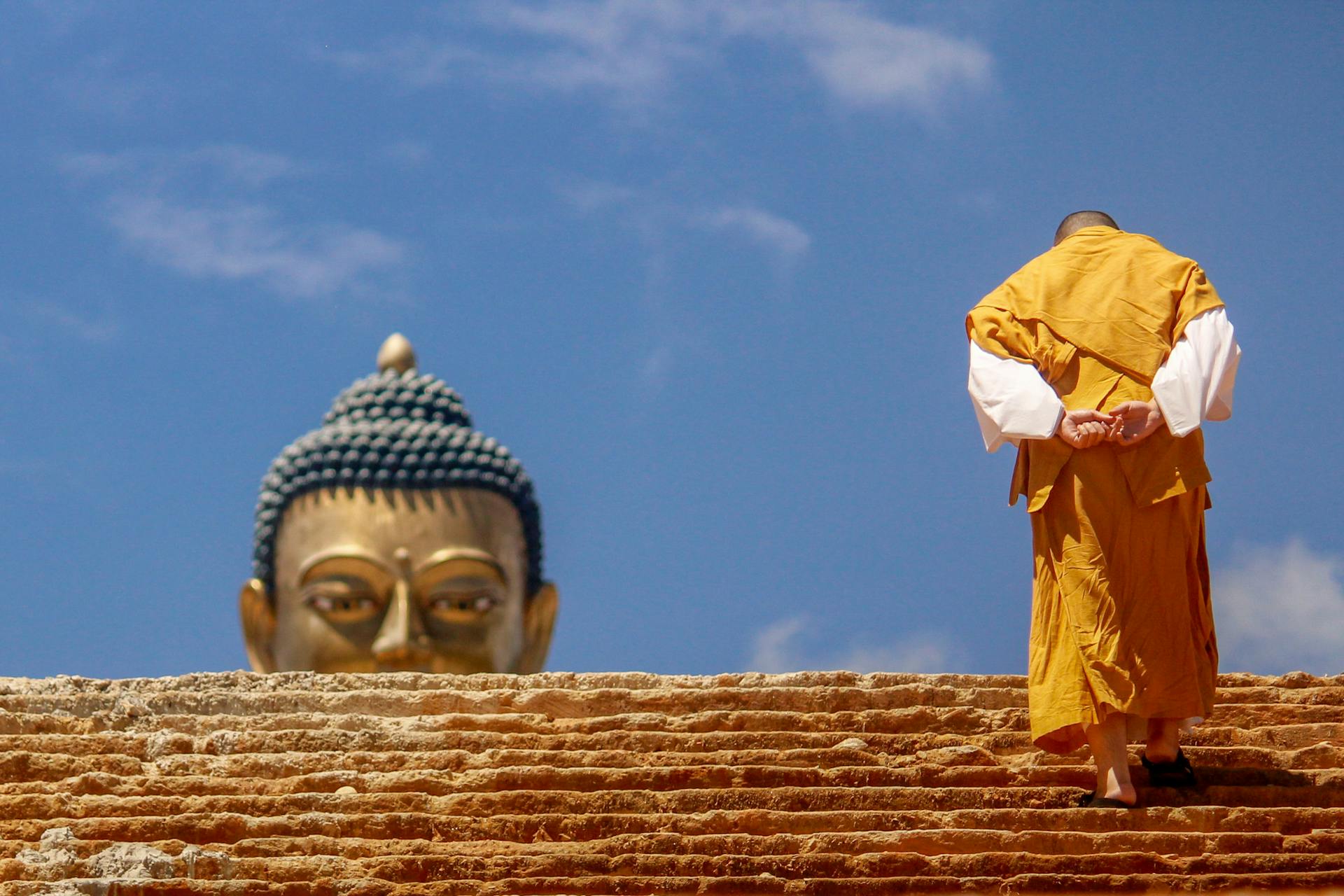
Moksha is the fourth and final aim of Purushartha, and it is the one modern life has the least language for.
Dharma, we understand, at least conceptually. Do the right thing. Live with integrity. Artha we understand extremely well. Earn, build, accumulate. Kama we understand in our bones. Want, pursue, enjoy.
But Moksha, the aim of liberation from the cycle of attachment, suffering, and the endless repetition of wanting and losing and wanting again, sits outside the vocabulary of almost every contemporary self-improvement framework, career guide, or cultural conversation.
And yet it is the one the ancient texts placed above all the others.
This is the third article in the Purushartha series. If you have not read the pillar piece on Purushartha or the article on Dharma, both are worth reading first. But this one stands alone.
What Moksha Actually Means
The word Moksha comes from the Sanskrit root muc, meaning to free or to release. Derived from that root, Moksha literally means freedom from samsara, the cycle of death, rebirth, and the accumulated weight of karma that keeps a soul returning to the same patterns lifetime after lifetime.
In its simplest expression, Moksha is freedom. Not the freedom of having more choices or more money or more time. Something older and stranger than that. Freedom from the very conditions that produce suffering in the first place.
The earliest traces of the concept appear in the ancient Vedic texts, but it was in the Upanishads, a body of philosophical texts written roughly between 800 and 200 BCE, that Moksha emerged as a fully formed and central idea. The Svetasvatara Upanishad teaches that bondage results from ignorance and delusion, and that deliverance comes through knowledge.
The Supreme Being dwells in every being as the eternal law and the essence of everything. Liberation comes to those who recognise that presence not as a distant theological idea but as a direct, lived reality.
That word, knowledge, is important. Moksha is not achieved through punishment, deprivation, or the performance of extraordinary suffering. It is achieved through the dissolution of ignorance about the nature of the self and reality. The path is inward, not upward.
By the time of the great epics, the Mahabharata and the Ramayana, Moksha had been established as the highest of the four Purusharthas. The other three, Dharma, Artha and Kama, are necessary stages. They are not abandoned or dismissed. But they are understood, in the fullness of the framework, as preparation for this fourth aim. Each prepares the ground. Moksha is the harvest.
The Two Forms of Liberation
One of the most important and least-known distinctions within Moksha is between two different kinds of liberation: Jivanmukti and Videhamukti.
Jivanmukti is liberation achieved within this lifetime, while still living in the body. The person who reaches it is called a Jivanmukta, a self-realised being. According to the Naradaparivrajaka Upanishad, a Jivanmukta shows specific and recognisable qualities. He is not disturbed by disrespect and endures cruel words without retaliation.
He treats others with respect regardless of how they treat him. When confronted by anger, he replies with soft and kind words. He does not seek to harm and is not harmed by the world in the way others are, not because the world has changed but because his relationship to it has.
This is not a personality type. It is a state of being that arises when the ego’s grip on identity loosens to the point where insults and praise stop carrying the same weight. The person is still fully present in the world. They still act, speak, relate. But they act from a fundamentally different ground.
Videhamukti is liberation after death, the release of the soul from the karmic cycle entirely after the physical body falls away. In this form, the soul does not return. It merges with what the Advaita Vedanta school calls Brahman, the universal consciousness underlying all of existence.
The distinction matters because it pushes back against a common misconception: that Moksha is only about what happens after you die. Jivanmukti insists that liberation is available in this life, right now, in the body you currently occupy. The goal is not to escape the world. It is to stop being enslaved by your own reactions to it.
The Four Paths to Moksha
Hindu philosophy does not prescribe a single method for reaching Moksha. It identifies four distinct paths, and the assumption is that different people, given their temperament and constitution, will find different paths more natural.
Karma Yoga is the path of action without attachment to outcomes. It is rooted in the Bhagavad Gita and argues that the problem is never the action itself but the ego’s investment in the result. Act fully. Act with discipline and care. But do not let your identity ride on whether the outcome matches what you wanted. This is perhaps the path most accessible to people living ordinary working lives, because it does not require retreat from the world. It requires a shift in the orientation brought to whatever is already being done.
Jnana Yoga is the path of knowledge and intellectual inquiry. It involves the sustained philosophical examination of the nature of reality, the self, and the relationship between the two. The Advaita Vedanta school, founded on the teachings of the philosopher Adi Shankaracharya in the eighth century CE, is the most rigorous expression of this path.
Its central claim is that the individual self and universal consciousness are not ultimately separate. The perception of separation is the illusion. Recognising this directly, not as a belief but as a lived experience, is liberation.
Bhakti Yoga is the path of devotion. It emphasises love and surrender to a personal form of the divine. For many Hindus, this is the most emotionally resonant path.
The Vaishnava traditions, devoted to Vishnu and his avatars including Krishna and Rama, place Bhakti above all other practices on the grounds that love directed entirely toward the divine naturally dissolves the ego’s separateness.
Raja Yoga is the path of meditative practice, the disciplined training of attention and awareness through techniques that progressively quiet the mind and reveal the consciousness that underlies it. This is the path most familiar to the contemporary West through the practice of meditation, though what is taught in most modern mindfulness programmes is a significantly stripped-down version of a far more comprehensive system.
All four paths lead to the same destination. The choice of which to walk is based on who you are, not on which one is correct.
What Modern Life Does to the Fourth Aim
Here is the honest problem.
Three of the four Purusharthas have entire industries built around them. Dharma has the ethics consulting sector, the corporate social responsibility movement, the coaching industry. Artha has finance, business, every self-help book ever written about money and success. Kama has advertising, entertainment, the wellness industry, and roughly sixty percent of everything on the internet.
Moksha has almost nothing.
There are retreats. There are meditation apps, though they are mostly used for stress reduction rather than liberation. There is a growing psychedelic therapy movement that is exploring what clinical researchers cautiously call ego dissolution, the temporary dissolving of the rigid sense of separate self, and which bears a striking resemblance to what the Upanishads described as a precondition for Jivanmukti.
Modern psychology increasingly recognises ego dissolution not as pathology but as a potentially therapeutic state that allows rigid patterns of thought and behaviour to be restructured.
That is a notable shift. But it is still framed in the language of mental health improvement rather than the language of liberation. The goal, in the clinical context, is a better-functioning self. The goal in Moksha is the recognition that the self as you have been experiencing it was never quite what you thought it was.
These are not the same goal.
Western culture, as one spiritual researcher observed, seems oriented toward cultivating hyper-individualism, continual striving and action, comfort-seeking, and selfishness. These are the precise conditions under which Moksha becomes not just difficult but unthinkable. You cannot pursue liberation while simultaneously optimising your personal brand. The directions are simply opposite.
Spiritual Bypassing: The Fake Version of Moksha
There is a phenomenon in contemporary spiritual culture worth naming directly: spiritual bypassing.
The term was coined by psychologist John Welwood in 1984. It describes the use of spiritual ideas and practices to avoid dealing with unresolved emotional wounds, psychological developmental needs, and unfinished life tasks. It is the person who uses meditation to avoid confronting grief. The person who interprets “non-attachment” as permission to avoid commitment. The person who claims to be “beyond ego” while behaving in ways that are deeply ego-driven.
This is not Moksha. It is a performance of Moksha used in service of Artha and Kama. And it is extremely common.
The Purushartha framework is actually quite specific about this risk. Moksha is listed last for a reason. The ancient texts are clear that the other three aims must be genuinely engaged with, not bypassed. You cannot skip Dharma and arrive at Moksha.
You cannot avoid Artha entirely and claim liberation while actually practising a kind of spiritual avoidance. The framework assumes that a person moves through these aims across a lifetime, fulfilling each in its appropriate stage, and that Moksha arises from that fullness rather than from the rejection of the earlier stages.
The Tirukkural, the ancient Tamil text of moral literature, makes the same point differently. It focused on the first three Purusharthas, Dharma, Artha and Kama, without addressing Moksha directly, suggesting that the proper pursuit of the other three will naturally lead the person toward the fourth. Live well. Live ethically. Live fully. The question of liberation will answer itself.
This is not a licence for indulgence. It is a precise observation about sequence. Liberation is not manufactured by forcing it. It is uncovered by living with enough honesty, integrity and depth that the illusions which obscure it become visible for what they are.
Moksha and the Crisis Nobody Can Name
There is a particular kind of suffering that appears with some regularity in contemporary life and that existing frameworks consistently fail to adequately describe.
It is not depression, exactly, though it can look like it. It is not burnout, though that word gets used. It is the specific exhaustion of a person who has achieved the goals they were told to pursue, met the markers of success they were given, and found that the arrival did not feel like what the journey promised.
The house. The income. The relationship. The status. The followers. Each thing, when finally obtained, provided a brief moment of satisfaction followed by the return of the same underlying restlessness. And then the pursuit of the next thing. And the one after that.
What Moksha names, with more precision than any clinical vocabulary currently offers, is the root cause of this pattern. The cycle of wanting, obtaining, briefly satisfying, and wanting again is samsara in miniature. It is the karmic wheel expressed through a single lifetime rather than across many. The suffering it produces is real.
The conventional solutions to it, more achievement, more therapy, more optimisation, do not touch the root because they are operating on the level of the cycle itself rather than on the level of what drives the cycle.
Moksha does not say: want less. It says: understand more clearly what you are, and the wanting that was causing suffering will lose its compulsive grip.
That distinction is subtle. It is also the difference between suppression and liberation.
The Aim Nobody Talks About, and Why That Might Be Changing
There are signs, tentative and uneven, that the cultural conversation is beginning to edge toward the territory Moksha has always occupied.
The explosion of interest in meditation, even in its commercial and stripped-down forms, reflects a widespread hunger for something beyond the accumulation loop. The growing clinical literature on ego dissolution and its therapeutic effects is Western science arriving, slowly and carefully, at territory the Upanishads mapped two and a half thousand years ago.
The popularity of books exploring mortality, impermanence, and the nature of consciousness suggests a generation increasingly willing to ask questions that cannot be answered by productivity systems or financial planning.
None of this is Moksha yet. But it is movement in the right direction, the slow recognition that the fourth aim exists, that it is real, and that no quantity of the other three will substitute for it.
The Upanishads were written for a culture that understood this from childhood. The framework was built into the understanding of what a human life was for. Moksha was not an advanced concept reserved for monks and philosophers. It was the natural horizon toward which an ordinary life, lived well and fully, was always heading.
The modern world removed that horizon. The unease that followed was predictable. The return to it, in whatever form it takes, is not regression. It is the completion of something that was always there, waiting for the other three aims to do their work.
Further Reading: Artha meaning: why getting rich is a spiritual duty, not a sin .
What is Dharma in Hinduism: the one goal modern life makes almost impossible


 Psychology · Sep 22, 2026Chimpanzees Have Accents. They Grow into Them.
 The Margin · Sep 17, 2026People Are Seeing Ads in Their Dreams.
 Slow Meridian · Sep 16, 2026Autumn Leaves