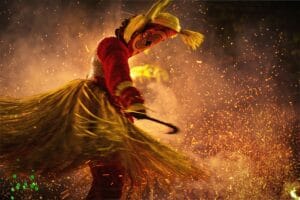
The Ashwatthama curse is not a punishment for what he did.
It is a punishment for what he became.
After the war ends, after the sleeping children are killed and the last fire dies, Krishna faces Ashwatthama in a field. He does not kill him. He takes the gem from his forehead, the one Ashwatthama was born with, the one that protected him from hunger, thirst, fear, and disease his entire life.
In its place: a wound that will not close.
And then the sentence. Wander for three thousand years. Covered in disease. Unloved. Unreachable. Unable to die.
The Mahabharata is never careless with its images. The wound is not decoration. It is the whole argument.
What the Ashwatthama Curse Actually Says
Ashwatthama was born with something most people spend their lives searching for.
Protection. The gem on his forehead was not jewellery. It was a shield against the most basic vulnerabilities. He never knew hunger the way others did. He never felt the particular fear that comes when the body reminds you how fragile it is.
Then his father died.
Dronacharya was told his son was dead. It was a lie, delivered strategically, in the middle of battle. He put down his weapons. He sat in grief. And in that moment of surrender, he was killed.
Ashwatthama watched.
What happened next in him is not described in the text with clinical language. The epic does not use words like dissociation or unprocessed grief. But it describes what those states produce with complete accuracy.
He attacked at night.
He killed sleeping children.
He destroyed what could not fight back.
This is what the Mahabharata records when a person’s grief has nowhere to go and no container to hold it.
What Psychology Calls This
Grief that cannot be processed does not disappear.
It changes form.
Psychologists studying prolonged grief disorder describe a state where the loss is so destabilising that the mind cannot complete the mourning cycle. The person does not move through grief. They are arrested inside it. Everything after the loss is experienced through the filter of that unresolved pain.
Ashwatthama lost his father. He lost the teacher who was also his father’s entire identity and purpose. He lost the gem, the protection, the self he had always been.
And he had no language for any of it. No ritual. No witness. No permission to fall apart.
So the grief became rage. The rage became action. The action became something the war itself had not produced.
He did not become cruel because he was evil. He became cruel because grief with no exit eventually burns through the walls.
The Gem and What Its Absence Means
The gem on Ashwatthama’s forehead was not simply protective.
It was his sense of invulnerability.
Psychology has a name for the belief that harm happens to other people. The illusion of personal immunity. It is not arrogance exactly. It is a baseline assumption that holds the self together. Most people carry it without knowing they do.
When it shatters, something structural breaks.
Ashwatthama carried his invulnerability literally, on his body, from birth. When Krishna removes the gem, he is not just taking jewellery. He is removing the psychological architecture that Ashwatthama had never been asked to build for himself.
The wound that replaces it is not metaphorical. But it is also not only physical.
It is the mark of a person who never learnt to be vulnerable because they never had to. And now must be, for three thousand years, with no possibility of resolution.
The Ashwatthama curse does not punish him with death. It punishes him with the life he was never equipped to live.
Why Immortality Is the Cruelest Part
Death would have been simpler.
Death allows the story to end. The grief to complete. The mourning to have a final object.
What Krishna gives Ashwatthama instead is duration without resolution. He must keep existing, but without the possibility of integration. Without the possibility of becoming someone who has processed what happened and arrived somewhere new.
This is what prolonged grief disorder looks like at its most severe.
Not dramatic collapse. Not visible destruction. Just continuation. A person still moving through the world, still breathing, still present, with an open wound where the self used to be, and no mechanism available to close it.
Modern psychology understands that grief requires three things to resolve.
Time. Witness. Meaning.
Ashwatthama has time in abundance. He has three thousand years of it.
What the curse removes is the other two. No witness who will sit with what he carried. No framework through which the loss of his father, his gem, his identity, his place in the world can be made to mean something.
Duration without meaning is not healing. It is just a longer wound.
What the Mahabharata Understood
Every major character in the epic carries an injury.
Karna carries abandonment. Draupadi carries humiliation. Yudhishthira carries the weight of a righteousness that cost everyone around him something.
What makes Ashwatthama different is that his injury has no arc.
The others move. They make choices inside their pain. They arrive somewhere. Even if what they arrive at is devastation, it is a completed devastation. The story closes.
Ashwatthama’s story does not close. That is precisely the point.
The Ashwatthama curse encodes something the Mahabharata understood about what happens when grief is weaponised before it is felt.
The weapon always turns inward eventually.
Not as guilt. Not as remorse.
As a wound that the body keeps open because closing it would require feeling everything that happened.
And that is the thing Ashwatthama has spent three thousand years not doing.
He is still out there, the tradition says. Still wandering. Still bleeding.
Still not ready to put down what he picked up in that field.
Read Next: What the Mahabharata Knew About Generational Trauma That Science Is Only Now Confirming
Dronacharya and Arjuna: Why He Chose a Student over His Own Son
Ahamkara: The Ego the Gita Actually Warned You About. It Is Not What You Think