
Brain rot was a joke until the neuroscience caught up with it.
Oxford University Press named it Word of the Year for 2024, defining it as the supposed deterioration of a person’s mental or intellectual state from excessive exposure to low-quality online content. The word itself is not new.
It first appeared in Henry David Thoreau’s Walden in 1854, as a criticism of what happens to a mind that consumes nothing of substance. One hundred and seventy years later, it came roaring back as internet slang, and then as something more serious.
In 2025, researchers published a meta-analysis in Psychological Bulletin, the flagship journal of the American Psychological Association. It covered 71 studies. Nearly 100,000 participants.
The conclusion was stated plainly: heavy consumption of short-form video is associated with measurable declines in attention, impulse control, and mental health.
The effect size was described as moderate, which in research terms means it is large enough to matter.
Brain rot is not a medical diagnosis. But it is, increasingly, a scientific phenomenon.
What Is Actually Happening in the Brain
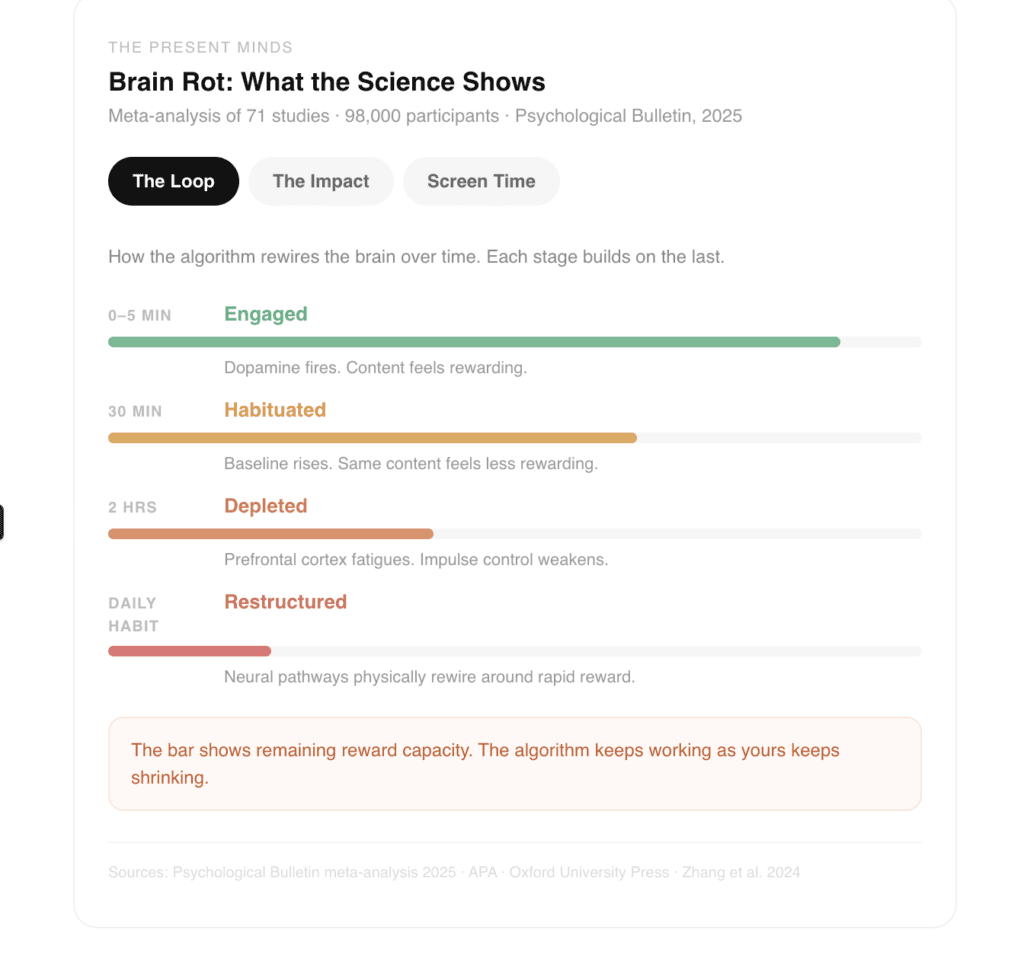
Every time you swipe to a new video, your brain releases a small amount of dopamine.
Dopamine is not a pleasure chemical in the simple sense that popular science often suggests. It is more precisely a prediction and reward signal. It fires when something unexpected and potentially rewarding appears.
Short-form video is engineered to maximise this response. Each swipe is a tiny gamble. The next video might be funny, surprising, beautiful, or infuriating.
The brain cannot know in advance. The uncertainty is the mechanism. The dopamine fires not because the content was satisfying but because it might be.
This is the same reinforcement schedule that makes slot machines so difficult to walk away from. Intermittent, unpredictable reward is the most powerful conditioning mechanism known to behavioural psychology.
The algorithm did not accidentally produce this effect. It was optimised for it.
Neuroimaging studies of heavy short-form video users are now showing structural consequences. Researchers have found reduced prefrontal executive function in heavy users, measured through EEG markers.
MRI studies show increased grey matter volume in reward-related brain regions, the brain physically adapting to a diet of rapid stimulation.
Functional connectivity between the prefrontal cortex and the amygdala, the pathway responsible for impulse control and emotional regulation, shows measurable weakening in individuals who meet criteria for short-form video addiction.
These are not subtle findings. The brain is changing in proportion to viewing time, in ways consistent with what is observed in other behavioural addictions.
The Attention Problem
The most consistently documented effect of heavy short-form video use is on sustained attention.
Sustained attention is the ability to maintain focused concentration on a single stimulus or task over time without being pulled away. It is the cognitive capacity that reading requires. That studying requires.
That meaningful conversation requires. It is, in a very literal sense, the capacity that makes deep engagement with anything possible.
What short-form video trains is the opposite. It conditions the brain to expect that nothing will last longer than 15 to 60 seconds before something new arrives. It conditions rapid disengagement from anything that does not immediately deliver reward.
The result, documented across studies in the UK, Jordan, Saudi Arabia, Egypt and the United States, is that heavy users find slower tasks progressively harder to tolerate. Reading feels tedious. Long meetings become unbearable.
A conversation that requires patience produces the urge to check the phone.
This is not a character failing. It is a trained response. The brain learned what the platform taught it.
One study found that heavy short-form video users showed significantly reduced brain wave activity during attention tasks compared to moderate users, suggesting a measurable impairment in the capacity to process and respond to new information when it arrives slowly.
Heavy users showed 30 percent lower information retention in academic settings. GPA declined in direct correlation with usage hours.
The ADHD question sits uncomfortably here. ADHD diagnoses in the United States have risen sharply over the same period that short-form video consumption exploded.
One researcher studying the overlap asked the question directly: are some of these diagnoses actually ADHD, or are they the measurable cognitive impact of years of heavy short-form video use?
No one has answered that definitively yet.

The Emotional Narrowing
There is a subtler effect documented in the research that receives less attention than the attention findings.
Heavy short-form video use appears to narrow emotional range. Short-form content primarily activates fast, instinctive, one-dimensional emotional responses. Surprise. Amusement. Disgust. Outrage.
These are reactions that resolve in seconds.They do not require empathy, perspective-taking, or sustained engagement with another person’s inner life.
Long-form content, whether films, longform journalism, novels, or even longer YouTube videos, activates a different emotional system. It requires following complex narratives across time.
It demands that you hold a character’s situation in mind long enough to develop genuine feeling about it. It exercises what psychologists call narrative transportation, the capacity to inhabit another perspective deeply enough to be changed by it.
Researchers studying heavy short-form users found reductions in empathy, emotional understanding, and the ability to anticipate how others might feel. Not because the users became less capable of these things as people.
But because the neural pathways that support them were being used less, and the pathways that support rapid, shallow emotional response were being used more.
Use what you practice. Stop practicing what you stop using. That is how the brain works.

What the Screen Time Numbers Actually Mean
The average person now spends between seven and ten hours daily looking at screens. Short-form video accounts for a significant portion of that. In the United States, average daily use across TikTok, YouTube Shorts and Instagram Reels adds up to more than two hours.
In China, short-form video accounts for 95 percent of all internet use. The short-form video audience in China alone surpassed one billion people in 2024.
These numbers are not descriptions of leisure activity. They are descriptions of the primary environment in which a generation’s cognitive architecture is being formed.
Generation Alpha, the first generation born entirely after the smartphone became ubiquitous, is now between 10 and 15 years old. The researchers who study brain rot are not primarily worried about adults who developed their attention spans before the algorithm existed.
They are worried about children whose attention spans are being shaped by it during the critical developmental window when those capacities form.
The Brain Rot Scale, a validated psychometric instrument developed in 2025 to measure digital content overconsumption, was designed specifically for people aged 8 to 24. That is the population the research is watching most carefully.

It Is Also Reversible
Here is what the research says that the discourse around brain rot tends to underemphasise.
The brain is plastic. The changes documented in heavy short-form video users are not permanent damage. They are learned patterns, and learned patterns can be unlearned. The neural pathways that sustained attention requires can be rebuilt by using them.
The dopaminergic reward circuitry that has been calibrated to expect rapid novelty can be recalibrated by exposure to slower, more demanding content.
The interventions that work are not dramatic. Creating friction, moving apps off the home screen, adding a password, requiring one deliberate action before opening, reduces impulsive use by measurable amounts.
Protecting sleep by avoiding short-form content in the hour before bed has documented effects on sleep quality, which has downstream effects on the cognitive performance that heavy use impairs.
Reintroducing long-form content, books, longform articles, films, podcasts, actively exercises the attention pathways that short-form use weakens.
None of this requires abstinence. The research does not suggest that short-form video is inherently harmful. It suggests that an unexamined, unlimited diet of it, delivered by an algorithm with no interest in your cognitive health, produces predictable effects.
Thoreau used brain rot in 1854 to describe what happens to a mind that consumes nothing of substance. He was writing about bad books and idle gossip.
He did not anticipate the algorithm. But he understood the mechanism.
Read next: The strange habit of opening instagram without intention

 Psychology · Sep 22, 2026Chimpanzees Have Accents. They Grow into Them.
 The Margin · Sep 17, 2026People Are Seeing Ads in Their Dreams.
 Slow Meridian · Sep 16, 2026Autumn Leaves