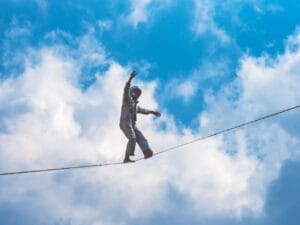
Social facilitation psychology begins with a cyclist and a stopwatch.
In 1898, Norman Triplett noticed something while reviewing official cycling records. Cyclists racing against other riders consistently posted faster times than cyclists racing against the clock alone.
He ran a controlled experiment to test it. Children winding fishing reels went faster when another child was doing the same task beside them than when they worked alone.
Triplett’s 1898 study is considered the first ever social psychology experiment ever conducted. What he had found was simple on the surface. People perform differently when others are present.
What he had not yet explained was why. Or why the effect sometimes goes completely the other way.

What Social Facilitation Actually Means
Social facilitation psychology refers to the tendency for people to perform differently on tasks when in the presence of others compared to when alone.
The word facilitation is misleading. It implies improvement. The reality is more complicated.
Research has shown that the presence of others can both improve and impair performance depending on the nature of the task.
The same audience that helps one person perform better makes another perform significantly worse. The difference is not confidence or personality. It is the task itself.
The Yerkes-Dodson Law
To understand why, you need one piece of background.
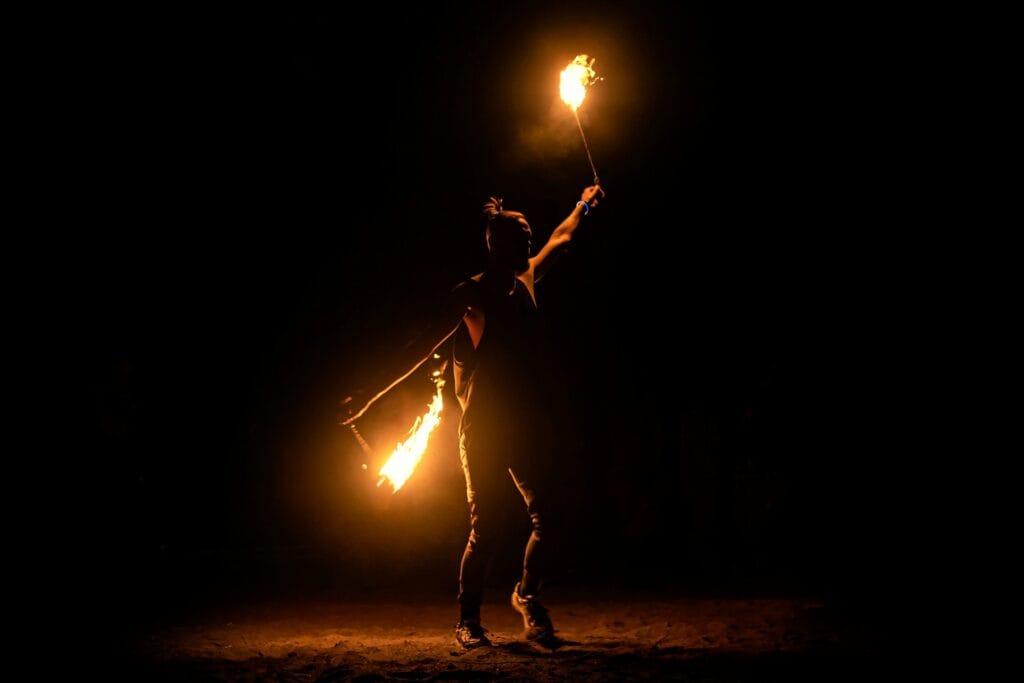
In 1908, psychologists Robert Yerkes and John Dodson established what became known as the Yerkes-Dodson law. The law describes an empirical relationship between arousal and performance. It states that performance increases with physiological or mental arousal up to a point, after which performance decreases as arousal becomes too high.
Think of it as a curve. Low arousal, low performance. Moderate arousal, peak performance. High arousal, performance collapses.
Being watched raises arousal. That is the mechanism. The presence of an audience activates the nervous system in a way that being alone does not.
For simple, well-practised tasks, that arousal lands in the optimal zone. The cyclist rides faster. The child winds the reel faster. The elevated state helps.
For complex or unfamiliar tasks, the same arousal pushes past the optimal zone. The nervous system is too activated to perform the precise, controlled movements the task requires.
Social facilitation psychology is not about confidence. It is about arousal meeting task complexity at exactly the wrong level.

Robert Zajonc and the Cockroach Experiment
The theoretical explanation came sixty years after Triplett’s cycling study.
In 1965, social psychologist Robert Zajonc proposed that the mere presence of others increases general arousal, which in turn strengthens the dominant response, the response most likely to occur in a given situation.
For well-learned tasks, the dominant response is the correct one. For tasks still being learned, the dominant response is often an error.
Zajonc tested this not with humans but with cockroaches. He found that cockroaches ran a simple straight maze faster when other cockroaches were watching from a plexiglass box. But they performed worse on a complex maze with multiple turns when observed.
The same pattern. Same species. Same observers. Different task complexity. Entirely different outcome.
Zajonc’s mere presence theory suggests that the mere presence of others is sufficient to produce social facilitation effects, without any evaluation or competition.
You do not need to be judged for the effect to occur. Simply being seen is enough.

The Stadium and the Sunday League
Picture Lionel Messi standing over a free kick.
Eighty thousand people. The stadium noise physical enough to feel in your chest. Cameras on his face. The weight of the match on the moment.
He scores. He almost always scores.
Now picture yourself in the same position. Same ball. Same distance. Same crowd. Different outcome entirely.
The difference is not courage. It is not mental strength in the motivational poster sense. It is something more precise.
Messi has taken that free kick, or something close to it, tens of thousands of times. The dominant response, the correct technique, the right contact point, the follow through, is so deeply practised that it is essentially automatic. The arousal the crowd produces pushes him to the optimal zone on the Yerkes-Dodson curve and keeps him there.
The stadium did not make him. It revealed what the training had already built.
The amateur has not taken that free kick ten thousand times. The dominant response is still uncertain. The same crowd, the same arousal, pushes past the optimal zone immediately. The technique that works in an empty park collapses under the lights.

Evaluation Apprehension
Later researchers complicated Zajonc’s pure presence model.
Nickolas Cottrell and colleagues found that observers who were blindfolded and therefore unable to evaluate the performer produced smaller social facilitation effects than observers who could see clearly.
This suggested something beyond mere presence. The concern about being evaluated was doing additional work.
Cottrell proposed evaluation apprehension theory, which states that it is specifically the concern about being judged by others that drives the arousal increase, rather than their presence alone.
Both effects are probably real. Presence raises arousal slightly. The possibility of judgment raises it further. Together they produce what most people experience as performance pressure.
What This Looks Like in Real Life
The penalty kick taken in front of eighty thousand people. The job interview. The first driving lesson with an examiner instead of a parent. The presentation to a room rather than to a screen.
In each case the task itself has not changed. The ability has not changed. What changed is the arousal level and whether that arousal helped or hurt.
Athletes who have extensively practised a skill tend to perform better under pressure because their dominant response is already the correct one. Novices performing the same skill under pressure tend to deteriorate because their dominant response is still an error.
This is why experienced performers often describe high-pressure situations as feeling easier rather than harder. The arousal is present. It simply lands at the right point on the curve.
It is also why being watched while learning something new is one of the most reliable ways to slow the learning down. The arousal that would help an expert hurts a beginner.
The audience does not change who you are. It changes what state you are in while you perform.
What the Research Confirms
Social facilitation psychology has been replicated across species, tasks, and settings for over a century. A meta-analysis of over 200 studies confirmed that the presence of others reliably improves performance on simple tasks and impairs performance on complex ones.
The effect holds whether the observer is a stranger, a friend, or a silent presence in the room. It holds in sports, academic testing, workplace settings, and laboratory conditions.
Even imagined audiences produce measurable effects. People who were asked to imagine being observed while performing tasks showed similar arousal patterns to those who were actually observed.
Which means the mechanism is not entirely about other people. It is partly about what the mind does when it registers that performance is being recorded, by anyone, including itself.
What Remains
Social facilitation psychology offers one genuinely useful insight.
The question before a high-pressure performance is not how to eliminate the arousal. Arousal is not the problem. It is how well the task has been practised relative to the state the audience will produce.
If the skill is deep enough, the audience becomes fuel.
If it is not, the audience becomes interference.
Triplett’s cyclists were not faster because they were more talented when racing side by side. They were faster because the presence of competitors pushed arousal into exactly the range their well-trained bodies needed.
The stopwatch alone was not enough to get them there.
Further Reading: Solomon Shereshevsky: The man who could not forget anything
What your brain is actually building while you are unconscious
The 5 Best AI Chatbots for Building a Website for Free
The Real History of Gaslighting (And Why Knowing It Changes Everything)